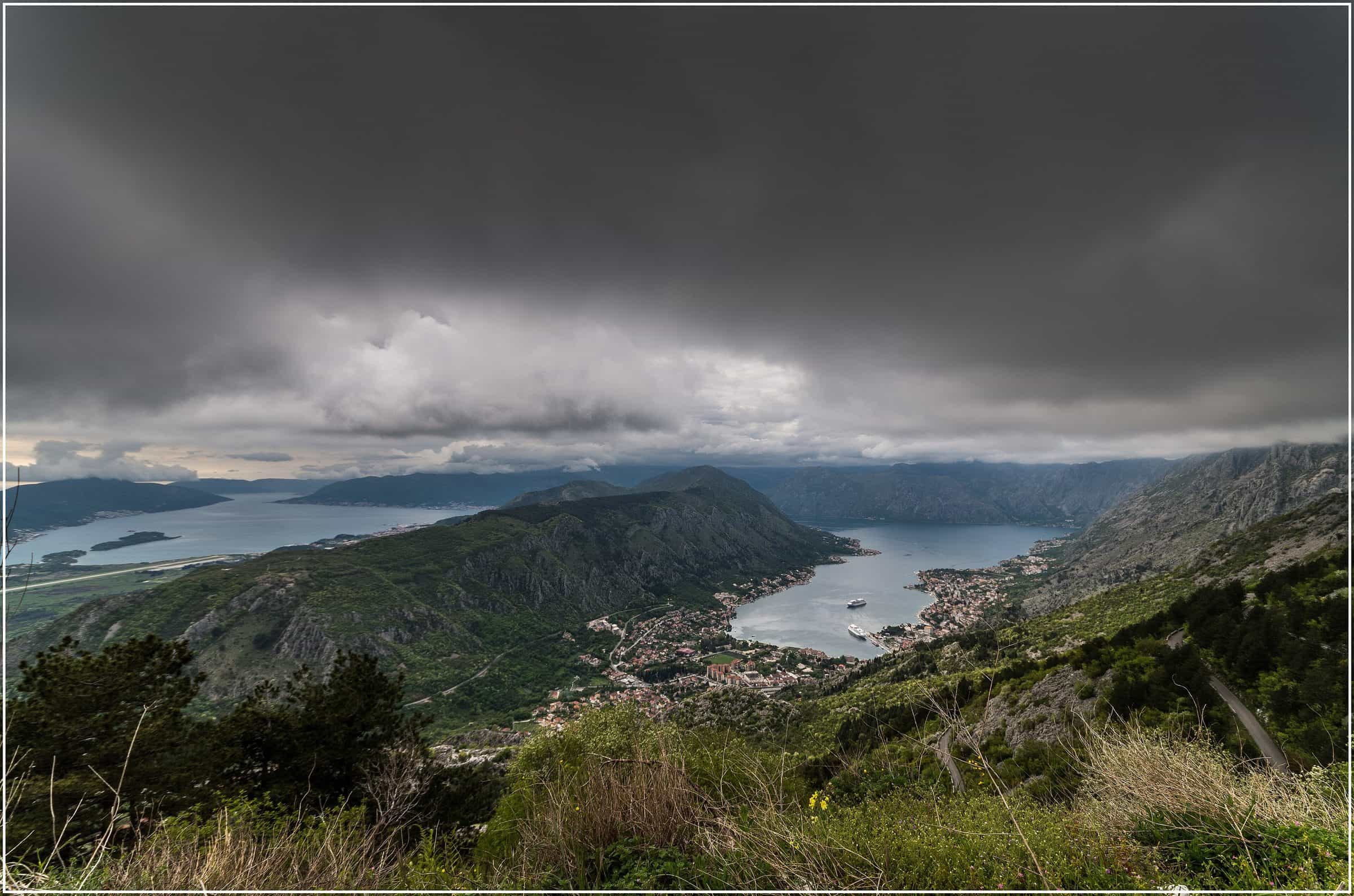
Weather in Montenegro: forecast by town
Photo: Arno Hoyer · CC BY 2.0

Montenegro has three climates, on the coast, in the central basin and in the mountains of the north, and the forecast below covers all of them, town by town, for the next seven days. On the coast, January averages 8 °C in Bar and Herceg Novi; in the Podgorica basin, July averages 26 °C with 23 days over 30 °C; and at Žabljak, 1,450 m up on the Durmitor plateau, January averages -4.5 °C with frost on 29 days of the month. Pick a town for its forecast, then read on for the climate behind it: what each region is like season by season, how warm the sea is, and when the north has snow.
Forecast by town
Not available right now. Check yr.no.
Coastal Region
Weather in Bar
Full forecastWeather in Budva
Full forecastWeather in Herceg Novi
Full forecastWeather in Kotor
Full forecastWeather in Tivat
Full forecastWeather in Ulcinj
Full forecastCentral Region
Weather in Cetinje
Full forecastWeather in Danilovgrad
Full forecastWeather in Nikšić
Full forecastWeather in Podgorica
Full forecastWeather in Tuzi
Full forecastWeather in Zeta
Full forecastNorthern Region
Weather in Andrijevica
Full forecastWeather in Berane
Full forecastWeather in Bijelo Polje
Full forecastWeather in Gusinje
Full forecastWeather in Kolašin
Full forecastWeather in Mojkovac
Full forecastWeather in Petnjica
Full forecastWeather in Plav
Full forecastWeather in Pljevlja
Full forecastWeather in Plužine
Full forecastWeather in Rožaje
Full forecastWeather in Šavnik
Full forecastWeather in Žabljak
Full forecastSki resorts
Weather in Cmiljača
Weather in Kolašin 1450
Weather in Kolašin 1600
Weather in Savin kuk
Weather in Žarski
Each card gives the next seven days for that town from MET Norway's forecast model, refreshed through the day, with the time of the last update. It is a model forecast for one point, not a measurement, and it stops at seven days: beyond a week a forecast says little more than the climate normals below, so there is no 15-day forecast here. The towns are grouped by region, with the ski areas at the end. For the base and the top of the ski areas, with the temperature adjusted to the height, use the snow forecast.
Coast, centre and north: the climate table
The long-term picture comes from the climate normals for 1961 to 1990, the reference period the national weather service (ZHMS) publishes for its stations. They describe a typical year, not this week. There is no station in Kotor or Budva: Herceg Novi stands for the Bay of Kotor and Bar for the Budva riviera.
| Station | January mean | July mean | July high (mean) | Rain per year | Sunshine per year |
|---|---|---|---|---|---|
| Herceg Novi (coast) | 8.2 °C | 24.3 °C | 29.4 °C | about 1,930 mm | about 2,430 h |
| Bar (coast) | 8.3 °C | 23.4 °C | 27.8 °C | about 1,390 mm | about 2,530 h |
| Ulcinj (coast) | 7.1 °C | 24.4 °C | 29.2 °C | about 1,260 mm | about 2,560 h |
| Podgorica (centre) | 5.0 °C | 26.0 °C | 31.8 °C | about 1,660 mm | about 2,480 h |
| Cetinje | 0.6 °C | 19.7 °C | 27.2 °C | about 3,300 mm | - |
| Nikšić | 1.4 °C | 20.5 °C | 26.7 °C | about 1,990 mm | about 2,240 h |
| Kolašin (north) | -2.1 °C | 15.7 °C | 23.8 °C | about 2,160 mm | about 1,810 h |
| Žabljak (north) | -4.5 °C | 13.9 °C | 19.5 °C | about 1,480 mm | about 1,930 h |
| Pljevlja (north) | -2.8 °C | 17.4 °C | 24.8 °C | about 800 mm | - |
Three things stand out. Cetinje is the wettest station, with about 3,300 mm a year and 500 mm in November alone. Podgorica is the hottest, with 18 tropical nights (minimum over 20 °C) in July. And the rain comes in winter, not summer: Bar averages five rain days in July and 14 in November, Herceg Novi six and 14. A rainy forecast in July is the exception; one in November is the rule.
Season by season
Winter, December to February
The coast is mild and wet: daytime highs of 12 to 14 °C in Bar and Herceg Novi, 13 to 14 rain days a month, and one to four frost days a month at most. Podgorica is colder at night, with a January mean of 5.0 °C and highs around 9.5 °C, and gets about 190 mm of rain in January. The north is another country: Žabljak averages -4.5 °C in January, with 49 cm of snow on the ground at the town station in January and 71 cm in February; Kolašin, at 944 m, has 17 cm and 24 cm.
Spring, March to May
April brings highs around 18 °C on the coast and 19 °C in Podgorica, but still 12 rain days a month in Bar. May is the turn of the year: highs of 22 to 23 °C on the coast and 24 °C in Podgorica, rain days down to nine in Bar, and the bathing season opens. Up at Žabljak, April still has 19 frost days and an average 23 cm of snow on the ground; Kolašin's highs reach 12.5 °C in April and 17.7 °C in May.
Summer, June to August
July highs average 28 °C in Bar, 29 °C in Herceg Novi and 32 °C in Podgorica, where 23 days of the month pass 30 °C and 18 nights stay above 20 °C. Bar has five rain days in July and about 350 hours of sunshine. The mountains are the escape: Žabljak's July highs average 19.5 °C with nights of 8 °C, Kolašin's 24 °C with nights of 9 °C.
Autumn, September to November
September keeps coastal highs of 25 to 26 °C and 27 °C in Podgorica, with seven rain days in Bar; October still has highs of 22 °C on the coast and nine rain days, and closes the bathing season. November is the wet month everywhere: 14 rain days in Bar, about 240 mm in Podgorica, about 310 mm in Kolašin and 500 mm in Cetinje. Kolašin already counts 16 frost days in November.
Sea temperature
The sea-temperature page shows the night-time sea-surface temperature at five points along the coast, from a satellite analysis (Copernicus Marine), with the last 14 nights so the trend is visible. Each value is for a sea cell about 1 km off the coast and is not a beach thermometer reading: at the beach in the afternoon the water is usually a little warmer. Kotor and Tivat share the point at the entrance to the Bay of Kotor. The bathing season runs from May to October, when Morsko dobro tests the bathing water and staffs the beaches with lifeguards, fully in July and August and with reduced cover in May, June, September and October.
Snow and mountain weather
Žabljak, the town for Durmitor, averages 29 frost days (minimum below 0 °C) and 12 ice days (maximum below 0 °C) in January, 28 and 9 in December, and still 19 frost days in April. Snow lies on the ground at the town station from November (7 cm on average) to April (23 cm), deepest in February at 71 cm; Kolašin, below Bjelasica, averages 26 frost days in January and 16 in November, with 24 cm of snow in February. These are town stations; the pistes lie 500 to 1,100 m higher. The traffic law's winter period, 15 November to 1 April, covers those months: a car driven in winter conditions then needs winter tyres on all wheels (Art. 132). Before driving north in winter, check the road conditions; the snow forecast gives the next seven days at the base and the top of each ski area, and the ski resorts pages carry each resort's season.


Warnings
Official weather warnings for Montenegro are issued by the national weather service, ZHMS, and published with its own forecast at meteo.co.me. Before a mountain day or a winter drive north, check there as well as here.
Where the data comes from
Forecast: MET Norway's Locationforecast, fetched through the day; each town shows the time of its last update. Climate: the ZHMS normals for 1961 to 1990 and its monthly snow-depth tables. Sea: the Copernicus Marine satellite analysis, one value per night and point.
Common questions
What is the weather in Montenegro in October?
October averages 16.8 °C in Bar and Ulcinj, 16.6 °C in Herceg Novi, 15.9 °C in Podgorica and 5.6 °C at Žabljak, with highs of 22 °C on the coast and 9 to 12 rain days. The bathing season ends this month. Use the forecast above for the actual week.
How warm is the sea in Budva in September?
The sea-temperature page gives a satellite value for each night at five points on the coast; Budva has its own point. The bathing season runs to the end of October, with lifeguards on the beaches in September and October at reduced strength.
Does it snow in Montenegro?
In the north, every winter. Žabljak averages 29 frost days in January and 49 cm of snow on the ground, 71 cm in February; Kolašin 17 cm and 24 cm. Each ski resort's season is on its own page. The coast sees one to four frost days a month in winter and rain rather than snow.
Is there a 15-day forecast?
No. The forecast here runs seven days, from MET Norway, and beyond a week the climate normals on this page are a better guide than any model. Official warnings come from ZHMS at meteo.co.me.
Which month is the wettest?
November. Bar has 14 rain days in November against five in July; Podgorica gets about 240 mm, Kolašin about 310 mm and Cetinje 500 mm in that one month. Summer is the dry season: Bar has about 37 mm in July.
How hot is Podgorica in summer?
July averages 26.0 °C, with mean highs of 31.8 °C, 23 days over 30 °C and 18 nights that stay above 20 °C. The coast is cooler, with July highs of 28 °C in Bar, and the mountains cooler still: 19.5 °C at Žabljak.
Related
Sources
- Zavod za hidrometeorologiju i seizmologiju, Klimatske normale 1961-1990 (11 stations)
- Zavod za hidrometeorologiju i seizmologiju, Klimatologija: visina snježnog pokrivača po stanicama (monthly snow-depth averages)
- Zakon o bezbjednosti saobraćaja na putevima, Art. 132 (winter period 15 Nov to 1 Apr; Paragraf.me consolidated text, current to 31.3.2021)
- JP Morsko dobro, Praćenje kvaliteta morske vode (May to October)
- JP Morsko dobro, Spasilačka služba (July-August; May, June, September, October)
- Copernicus Marine Service, Mediterranean Sea night-time sea-surface temperature analysis (SST_MED_SST_L4_NRT_OBSERVATIONS_010_004)
- MET Norway, Locationforecast 2.0 (seven-day point forecast)