Flying a drone in Montenegro: rules and no-fly zones
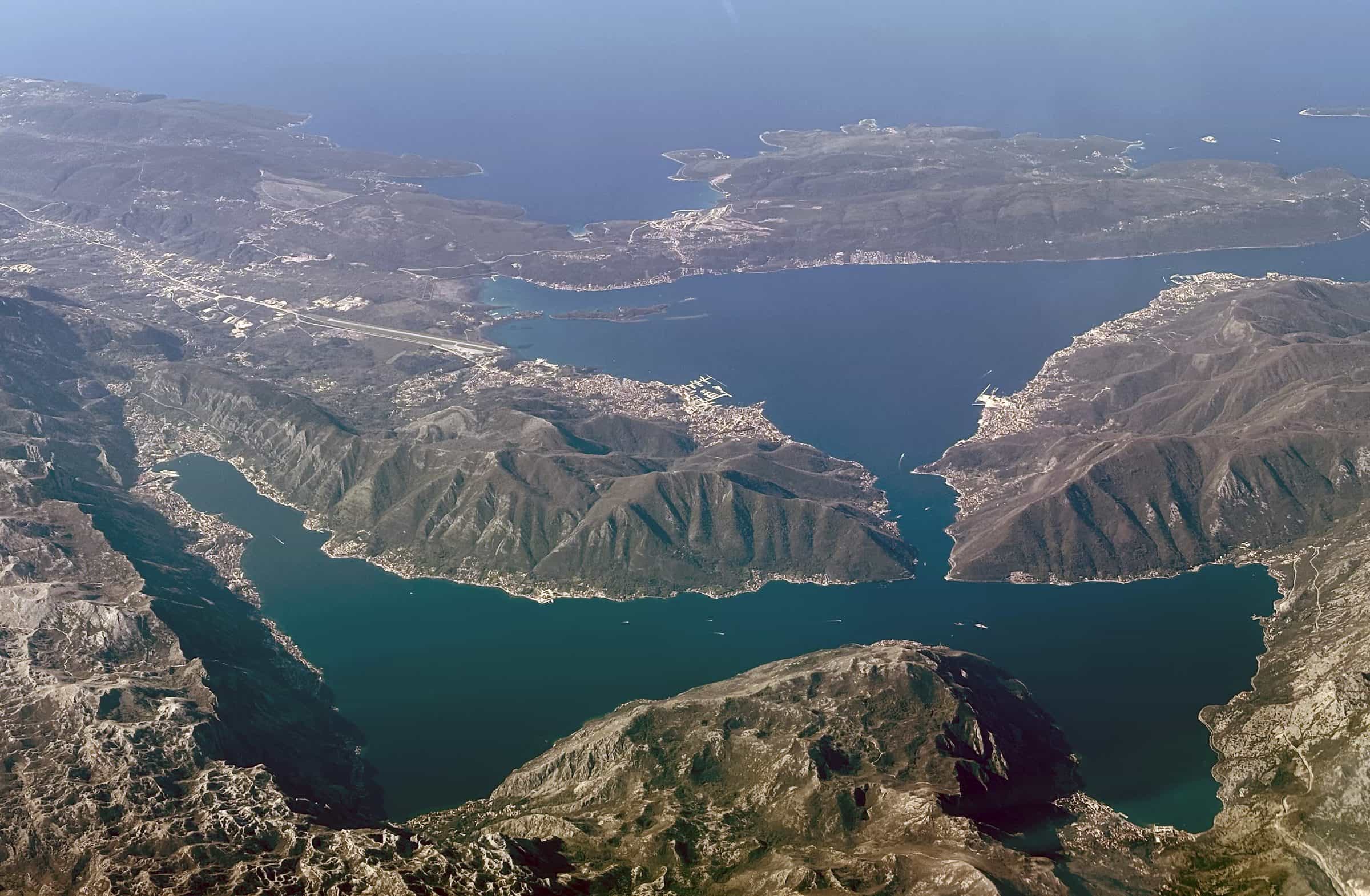
Photo: kallerna · CC BY-SA 4.0

Drone rules in Montenegro follow the EU model: open, specific and certified categories, C0 to C4 weight classes, registration from 250 g or for any camera drone, a ceiling of 120 m and no flying over crowds. They have applied since 1 July 2024 and rest, since 25 April 2026, on the new Law on Air Traffic. The only published no-fly areas are the 4 km core zones around Podgorica and Tivat airports; in the rest of the two airport control zones the limit is 50 m above ground without approval. In the five national parks a drone flies only with two permits and the parks company's approval. Registration runs online at dron.caa.me. Rules and zones can change, so check the Civil Aviation Agency's drone page before you fly.
Older guides, a 2019 notice and the airports' own "No Drone Zone" page still give the 2016 limits: registration from 0.5 kg, 150 m height, 500 m range, a night ban. They stopped applying on 1 July 2024.
Who regulates and which rules apply
The regulator is the Civil Aviation Agency (Agencija za civilno vazduhoplovstvo, CAA). Two texts matter. The Law on Air Traffic (Sl. list CG 52/2026, published 17 April 2026, in force 25 April 2026) sets the framework in its Chapter VIII, Arts. 91-103, with the fines in Arts. 235-238. The CAA Rulebook on conditions for the safe use of unmanned aircraft systems (Sl. list CG 24/23, amended by 117/23, 75/25 and 73/26) holds the detail: it takes over EU Implementing Regulation 2019/947 as its Annex 1 and applies the EASA guidance material, so a pilot who knows the EU rules will find the same classes, subcategories and limits. The rulebook replaced the 2016 rules, and every operator registered before 1 July 2024 had to register again.
Categories and weight classes
The law sets three categories. Open-category flights need no prior authorisation unless a geographic zone requires one (Art. 92). Specific-category flights need an operational authorisation from the CAA or a declaration it has accepted (Art. 93). The certified category covers high-risk operations such as carrying people or dangerous goods (Art. 94) and does not concern visitors.
In the open category the drone weighs under 25 kg, keeps a safe distance from people and never flies over an assembly of people, stays within the pilot's sight (follow-me mode or an observer excepted), stays at most 120 m above the nearest point of the ground, carries no dangerous goods and drops nothing.
| Class | Weight | Subcategory and distance to people | Operator registration | Pilot |
|---|---|---|---|---|
| C0 | under 250 g | A1: may fly over uninvolved people, never over assemblies | Only if it has a camera or sensors and is not a toy | No exam (read the manual); age 16 unless the drone is a toy |
| C1 | under 900 g | A1: overflight of uninvolved people kept to a minimum, never over assemblies | Yes | Online A1/A3 training and exam, age 16 |
| C2 | under 4 kg | A2: no overflight of uninvolved people, 30 m horizontal distance (5 m in low-speed mode); or A3 | Yes | A1/A3 exam plus self-practical training, a declaration and an extra theory exam for A2, age 16 |
| C3, C4 | under 25 kg | A3: only where no uninvolved person is endangered, at least 150 m from residential, commercial, industrial or recreational areas | Yes | Online A1/A3 training and exam, age 16 |
Privately built drones under 250 g fly as A1; privately built drones under 25 kg fly as A3.
Drones without a C class label
A drone with no C0-C4 label (many earlier DJI models) flies under transitional rules until 11 January 2027, a date set by amendment 73/26 of 27 May 2026: under 500 g as A1; under 2 kg with A2-level competence and at least 50 m horizontally from people; under 25 kg as A3. From 11 January 2027 an unlabelled drone flies only as A1 (under 250 g) or A3 (under 25 kg), or in the specific category. Guidance leaflets printed earlier still show the old deadlines (30 June 2025, 31 May 2026) and a 30 m distance; the rulebook text, with the January 2027 date and 50 m, is the one in force.
Registration at dron.caa.me
An operator registers for any open-category drone of 250 g or more (or with more than 80 J of impact energy), for any drone with a camera or another sensor that can collect personal data, and for every specific-category flight. Weight does not matter for a camera drone: the only exception is a camera drone under 250 g that is legally a toy. A person registers in the state where they live and may not be registered in two states at once. The registration number goes on every drone the operator flies.
Residents register online at dron.caa.me (login page in Montenegrin and English; support at dron@caa.me). An individual gives name, date of birth, a scanned ID or passport, address, email, phone number, and the insurer and policy number. The result is one e-ID with a secret code, valid two years and renewed the same way; if the drone has a remote-ID system, the number is coded into it. The pilot exam runs on the same portal.
Exam and registration were free when the system opened in July 2024. The 2026 law (Art. 100) lets the CAA charge a registration fee with the Ministry's consent, so check dron.caa.me for any fee when you register. Operators registered in an EU member state do not register in Montenegro: see travelling to Montenegro with a drone.
Pilot age, exam and insurance
- Age: 16 in the open and specific categories. Exceptions: toy C0 drones, privately built drones under 250 g, flying under the direct supervision of a qualified pilot aged 16 or over, and (since amendment 75/25) under-16s in model-aircraft clubs under supervision.
- Exam: the online A1/A3 training and exam for C1-C4; A2 operation of a C2 drone adds self-practical training, a declaration and a further theory exam.
- Insurance: third-party liability insurance under the Law on Compulsory Traffic Insurance; a foreign operator needs a policy that covers Montenegro or the EU. No minimum sum is set.
Height and distance from people
The ceiling in the open category is 120 m above the nearest point of the ground. The distance from people depends on the subcategory: A1 drones may fly over uninvolved people (C1: as little as possible); A2 drones keep 30 m horizontally, or 5 m in low-speed mode; A3 drones fly only where nobody uninvolved is endangered and at least 150 m from residential, commercial, industrial or recreational areas; unlabelled drones between 500 g and 2 kg keep 50 m. No drone in the open category flies over an assembly of people.
An assembly is defined by whether people can move away, not by a head count. Sports, cultural, religious and political events count, as do beaches and parks on a sunny day, busy shopping streets, ski slopes, and people walking or driving in the street. Flying over any outdoor gathering needs CAA approval in the specific or certified category. For a visitor this rules out a summer beach, the old towns of Kotor and Budva in season, and any festival crowd.
Airport zones: Podgorica and Tivat
Safety Order 2017/001 (rev. 03, 1 July 2024) governs the control zones CTR Podgorica and CTR Tivat. In a core area around each runway, bounded by arcs of 4 km radius (coordinates and a green line on the order's maps), no drone flies without approval from AMC Montenegro and a NOTAM. In the rest of each control zone you may fly up to 50 m above ground without approval; 50-120 m needs AMC approval. Part of CTR Tivat lies over Kotor municipality, so the 50 m limit applies in that part of Kotor municipality too; the exact boundary is on the order's map. "No Drone Zone" signs have stood at both airports since 2019.


To get approval, email the form in Annex 3 of the order to amc.mne@smatsa.rs at least two working days before the flight, by 10:00 UTC, one request per flight. On the day, phone the tower to report the start and end of the flight (Podgorica +382 20 414 004, Tivat +382 20 414 059) and stay reachable on the mobile number you gave. AMC Montenegro answers on +382 20 414 041, 011 or 019.
Both airports have their own pages: Podgorica Airport and Tivat Airport.
Police checks in Tivat and Kotor
The CAA has agreements on illegal drone use with the municipality of Tivat (21 October 2025, the first of its kind, chosen because of the airport) and with Kotor (announced 7 November 2025, because part of the Tivat control zone covers its territory). Municipal police in both towns may identify a drone pilot and check operator registration and pilot certificates, and the CAA shares with them the zones where drones are banned, restricted or allowed under conditions. Carry proof of registration, your exam certificate and the insurance policy when flying in either municipality, on paper or on your phone.
Other no-fly zones
Under the 2026 law the Airspace Board sets UAS geographic zones for safety, security, privacy or the environment; a flight inside one needs approval, the CAA publishes the zones in a single digital format (Art. 101), and the pilot checks the current zones before every flight (Art. 97). The published airspace information (the eAIP, section ENR 5.3) lists no such zone for Montenegro, and no prohibited, restricted or danger area in section ENR 5.1 lies inside the country. The two airport control zones are therefore the only published drone restrictions, and there is no official no-fly map. Military sites, the border strip, Kotor Old Town, Perast, Ostrog and the Cetinje monasteries have no drone rule of their own; the general limits on crowds, height and privacy apply there as everywhere. Once zones are set, their web address goes into AIP section ENR 5.3 (amendment 75/25).


National parks
A drone flight for filming in Durmitor, Biogradska gora, Lovćen, Skadar Lake or Prokletije needs three documents under the parks company's rules of 1 July 2026: a filming permit from the Environmental Protection Agency, a Civil Aviation Agency document if the drone weighs more than 249 g, and the approval of the National Parks of Montenegro (npcg@nparkovi.me, +382 20 60 10 15). Commercial filming costs €200 per day for feature and commercial films and €400 per day for music videos and adverts; the three documents apply to drone filming in general. Under the Law on National Parks (Sl. list CG 28/14), commercial filming or photography without approval is fined €100-4,000 for an individual and €1,000-40,000 for a legal person. Fees and opening of each park are on the national parks page.
Night flights
The open category has no general night ban, but at night the drone's green flashing light must be switched on (Annex 1, UAS.OPEN.060); a drone without such a light cannot fly after dark. The night ban on the airports' "No Drone Zone" page and in the 2019 notice belongs to the 2016 rules. Inside the airport control zones the 50 m limit and the core-area ban apply at any hour.
Filming people
The Criminal Code penalises unauthorised photography and the unauthorised publication or display of another person's image or recording. The rule applies to drone footage as to any other camera.
Fines under the 2026 law
The Law on Air Traffic lists drone offences in Arts. 235-238. Arts. 237 and 238 name some of the same pilot offences with different ranges; the law stands as published.
| Who | Offence (examples from the law) | Fine |
|---|---|---|
| Pilot (Art. 237) | Flying without the required age, competence or knowledge of the manual; not checking geographic zones | €50-200, plus a possible ban of 2-6 months |
| Pilot (Art. 238) | Unsafe flying; the same competence and zone-check failures; flying in a zone without approval | €500-2,000 |
| Operator, natural person (Art. 235) | e.g. not registered | €20-200, plus a possible ban of 2-6 months |
| Operator, legal person (Art. 235) | e.g. not registered; flying in a zone without approval | €500-2,000 |
| Operator, legal person (Art. 236) | e.g. specific-category flights without authorisation; flying in a geographic zone without approval | €1,000-20,000 |
Art. 236 applies to operators that are legal persons and carries no fine for private individuals. National park fines are listed above.
Before each flight
- Registered operator (from 250 g or any camera drone), number on the drone, pilot certificate and insurance to hand.
- Below 120 m, in sight, never over a crowd; keep the distance your subcategory requires.
- Not inside the 4 km core areas at Podgorica and Tivat; at most 50 m above ground elsewhere in the two control zones, including the Kotor side of the Tivat zone.
- No flight in a national park without the two permits and the parks company's approval.
- Drone without a C label: the transitional rules end on 11 January 2027.
Common questions
Do I have to register my drone in Montenegro?
Yes if it weighs 250 g or more or has a camera, unless it is a toy: the operator registers at dron.caa.me. Registration is valid two years. Operators registered in an EU member state do not register again in Montenegro.
How high can I fly?
120 m above the nearest point of the ground in the open category. Inside the Podgorica and Tivat control zones the limit is 50 m without approval, and the 4 km core areas around the runways are closed without AMC Montenegro approval.
Can I fly a drone in Kotor?
Part of the Tivat airport control zone covers Kotor municipality, so the 50 m limit applies there and the municipal police check pilots' registration under a 2025 agreement with the CAA. Kotor Old Town has no separate drone rule, but its busy streets count as an assembly of people, which the open category never overflies.
Can I fly a drone over a beach?
Not over a beach with people on it: a beach on a sunny day counts as an assembly of people. Flying over an outdoor gathering needs CAA approval in the specific or certified category.
Can I fly in Durmitor or another national park?
Only with a filming permit from the Environmental Protection Agency, a CAA document for a drone over 249 g, and the approval of the National Parks of Montenegro. Commercial filming costs €200 or €400 per day.
What is the fine for flying without registration?
Under the 2026 law an unregistered operator who is a natural person pays €20-200 (Art. 235); a pilot flying without the required competence or without checking zones faces €50-200 (Art. 237) or €500-2,000 (Art. 238). Under Arts. 235 and 237 a flying ban of 2 to 6 months can be added.
Related
Sources
- Zakon o vazdušnom saobraćaju, Sl. list CG 52/2026 (17.4.2026, in force 25.4.2026), Chapter VIII and Arts. 235-238
- CAA, Pravilnik o uslovima za sigurnu upotrebu sistema bespilotnih vazduhoplova, Sl. list CG 24/23 (EU 2019/947 as Annex 1)
- CAA, Letačke operacije: bespilotne letilice (rulebook, amendments, safety order, forms)
- CAA, Pravilnik o izmjenama Pravilnika, Sl. list CG 117/23 (start moved to 1.7.2024)
- CAA, Pravilnik o izmjenama Pravilnika, Sl. list CG 75/25 (10.7.2025)
- CAA, Pravilnik o izmjeni Pravilnika, Sl. list CG 73/26 (27.5.2026, transition to 11.1.2027)
- CAA, Kako vršiti operacije dronovima u otvorenoj kategoriji (guide by class)
- CAA, Uslovi izvođenja operacija dronovima koji nemaju C oznaku (25.7.2025)
- CAA, Izvođenje letova dronovima u blizini ljudi
- CAA, Poštujte pravila za dronove i letenje iznad skupova ljudi (21.2.2025)
- CAA, Registracija operatora sistema bespilotnih vazduhoplova
- CAA drone portal (registration and exam)
- CAA, Pilot examination and registration of drone operators (25.7.2024)
- CAA, Polaganje ispita za pilote i registracija operatora dronova (23.7.2024)
- CAA, Safety Order 2017/001 rev. 03, UAS operations in CTR Podgorica and CTR Tivat (1.7.2024)
- CAA, No Drone Zone signs at Podgorica and Tivat airports (23.7.2019)
- Montenegro Airports, No Drone Zone (outdated 2016 rules)
- CAA, agreement with Kotor on illegal drone use (7.11.2025)
- CAA, agreement with Tivat on illegal drone use (21.10.2025)
- SMATSA eAIP, AIRAC of 29.10.2026, ENR 5.1 and ENR 5.3 (Montenegro: NIL); current edition via the start page
- National Parks of Montenegro, Pravila o snimanju, fotografisanju i upotrebi drona u NPCG (1.7.2026)
- Zakon o nacionalnim parkovima, Sl. list CG 28/2014, Art. 16
- CAA, 266 registered drone operators (10.6.2019, old 2016 rules)
- eAIP Serbia and Montenegro, AIRAC AMDT 9/26 (1.10.2026), ENR 5.3