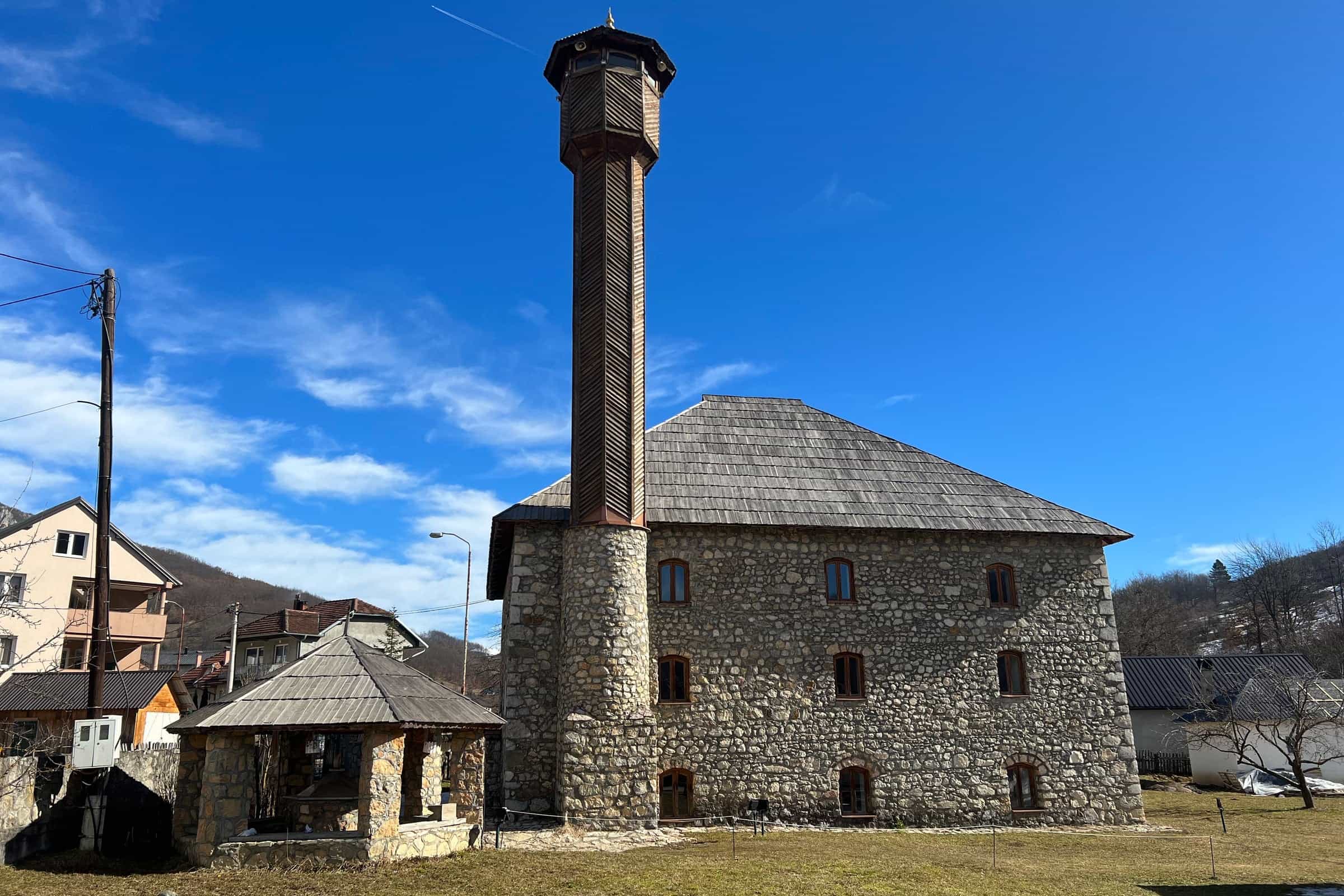
Petnjica Mosque
The only three-storey mosque in Montenegro, with a wooden minaret, carved wooden galleries and more than 500 Bihor rugs on its floors, in the centre of Petnjica
Three-storey stone mosque with a wooden minaret · Centre of Petnjica
Photo: Planeti · CC BY-SA 4.0
The Petnjica Mosque (Petnjička džamija, also called the Old Mosque) is the central and largest mosque of upper Bihor and the only three-storey mosque in Montenegro: a stone building of 15.80 by 13.20 m with a wooden minaret, two wooden galleries on carved pillars and all three floors covered in Bihor rugs. It stands in the centre of Petnjica, 105 m (1-2 minutes on foot) from the town centre, beside the road down the Popča valley towards Bioča. It is a working mosque with no published visiting hours: ask locally when you can go inside.
- Type Three-storey stone mosque with a wooden minaret, the only one of its kind in Montenegro
- Size 15.80 x 13.20 m, about 500 m² of prayer space over three floors, room for about 1,000 to 1,200 worshippers
- Rugs All three floors covered with Bihor rugs and kilims, more than 500 of them
- Rebuilt Enlarged at the start of the 20th century; rebuilt and reopened in 2005
- Where Centre of Petnjica, 105 m from the town centre; 17 km from Berane
Visiting
The mosque is in daily use. No visiting hours, rules or entry fee are published, so ask in the town when non-worshippers can go in; the building, the wooden minaret and the stone fountain in the courtyard can be seen from outside at any time. From the centre of Petnjica it is a walk of 105 m.
Good to know: The rugs are on the floors of the prayer rooms, so you see them only inside. Ask locally before you plan a visit around them.
The building
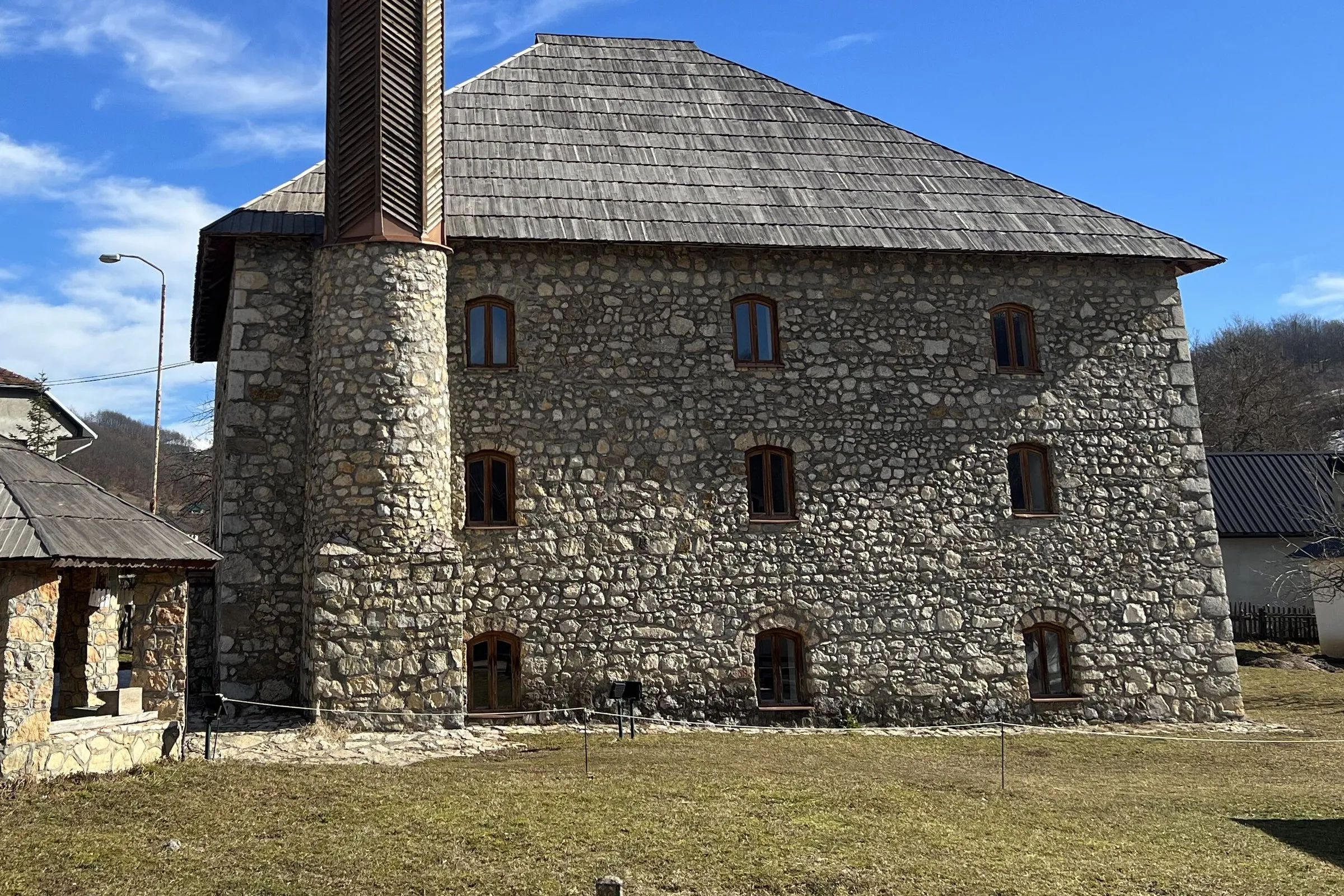
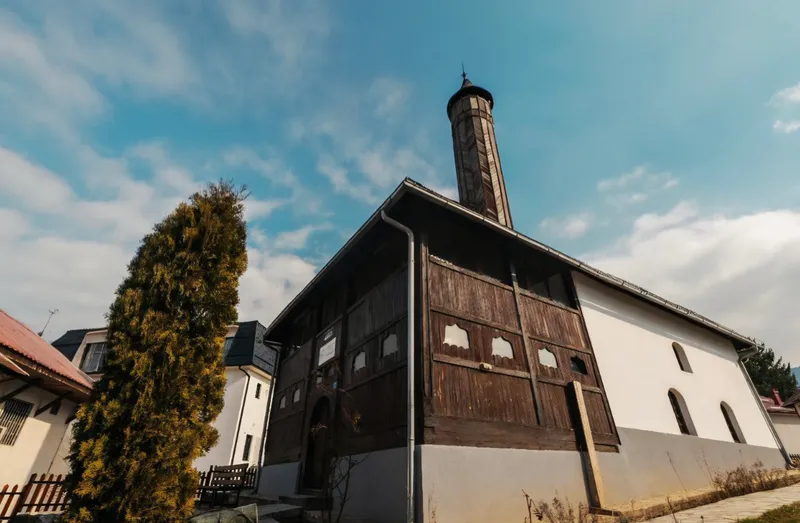
The footprint is 15.80 by 13.20 m and the mosque rises through three storeys under a four-sided timber roof. The walls are of roughly dressed stone, 80 cm thick on the two lower floors and 50 cm on the top floor. Thirty-five wooden windows light the rooms, eight on the entrance side and nine on each of the other three, each about 112 by 75 cm with a slightly arched head. The wooden minaret, with one balcony (šerefe) and a conical wooden cap, rises from a round stone base against the west wall.
Inside, two wooden galleries (mahfil) sit one above the other facing the mihrab, carried on hand-carved wooden pillars; the mihrab is stone, the minbar wood, and the entrance has a porch under a small dome. Some of the carved pillars are old: in the 2005 rebuild four were restored and the rest are new. The three floors give about 500 m² of prayer space.
The rugs
What sets the mosque apart inside is the floor: all three storeys are covered with Bihor rugs and kilims of local wool, woven by weavers of the Bihor villages. There are more than 500 rugs from different periods, the largest rug collection in Montenegro. The Bihor rug is woven into local life, given at sworn brotherhoods and marriages and passed down as heritage.
History
The date of building is not recorded and no founding document has been found. Tradition places a first small mosque here in the 16th century, and Petnjica's coat of arms shows the mosque as a 16th-century building beside a fortress; historians put it in the late 17th century or soon after, with one reading linking it to the arrival of Hajdar-paša in 1689. A local tale says its stone came from the mosque inside the medieval Bihor fortress. The first mosque had a stone lower floor, a wooden upper floor, a wooden minaret and a timber roof.
At the start of the 20th century (1901 or 1903) local gifts paid for the enlargement to today's footprint and three storeys. Repairs followed in the socialist period, but by the late 20th century the walls were cracked, the roof leaked and the minaret was damaged. A rebuild over several years, funded by Mustafa Mujko Šabotić and his family under the Ministry of Culture's conditions, ended with the reopening in 2005.
For a long time this was the only mosque in upper Bihor, and mekteb classes were held in it for generations. Registers of births and marriages are still kept in its archive.
Getting there
The mosque is 105 m (1-2 minutes on foot) from the centre of Petnjica, beside the road down the Popča valley towards Bioča. By car Petnjica is 17 km from Berane (about 25 minutes), 30.3 km from Rožaje (about 42 minutes) and 33.9 km from Bijelo Polje (about 40 minutes).
Nearby
- Petnjica, the town centre, 105 m.
- Polimski muzej in Berane, 17 km, where finds from the Torine site near Petnjica are kept.
- The caves of the Petnjica area, on the caves page.
- Other mosques of the north: the Old (Imperial) Mosque in Plav, the Vizier's Mosque in Gusinje and the Husein-pasha Mosque in Pljevlja.
Questions
Why is the Petnjica Mosque unusual?
The Petnjica Mosque is the only three-storey mosque in Montenegro, and all three floors are covered with Bihor rugs, more than 500 of them.
When was the Petnjica Mosque built?
The Petnjica Mosque has no recorded building date: tradition says the 16th century, historians the late 17th; it was enlarged at the start of the 20th century and rebuilt in 2005.
Can visitors go inside the Petnjica Mosque?
The Petnjica Mosque is a working mosque with no published visiting hours; ask locally when non-worshippers can enter.
How many people does the Petnjica Mosque hold?
The Petnjica Mosque holds about 1,000 to 1,200 worshippers on about 500 m² of prayer space over three floors.
Timeline
16th or 17th century
First mosque
A first small mosque stands here: tradition says the 16th century, historians the late 17th century or soon after; no founding document is known.
Early 20th century
Enlarged to three storeys
Local gifts pay for the enlargement to the present footprint and three storeys (1901 or 1903).
20th century
Repairs and decay
Repairs in the socialist period; by the late 20th century the walls are cracked, the roof leaks and the minaret is damaged.
2005
Rebuilt and reopened
After a rebuild over several years, funded by Mustafa Mujko Šabotić and his family under the Ministry of Culture's conditions, the mosque reopens.

More churches & monasteries
Nearest by road first

Sources
National Tourism Organisation, Charming mountain towns (three-storey mosque, hand-carved pillars, more than 500 rugs, the Bihor rug in community life) · National Tourism Organisation, The Crown of Montenegro panoramic road brochure (capacity up to 1,200, only three-storey mosque in Montenegro) · Regional Development Agency for Bjelasica, Komovi and Prokletije, Katun Roads, Sacral objects (three storeys, 15.80 x 13.20 m, largest rug collection, legend and 1689, Bihor fortress tale, original form, enlargement 1901, reconstruction 2005, registers) · Opština Petnjica, municipal symbols (coat of arms with a 16th-century mosque and a fortress) · Izet Šabotić, The old mosque in Petnjica-Gornji Bihor: architectural-cultural characteristics and religious-educational significance, 8th International Symposium on Balkan History Studies, Livre de Lyon, 2022, pp. 49-75 (dimensions, walls, 35 windows, minaret, galleries, pillars, 500 m², about 1,000 worshippers, rugs of local wool, dating, enlargement 1903, decay, 2005 rebuild by the Šabotić family, mekteb) · OpenStreetMap way 392602368, ODbL · OSRM routing (OpenStreetMap data, ODbL)