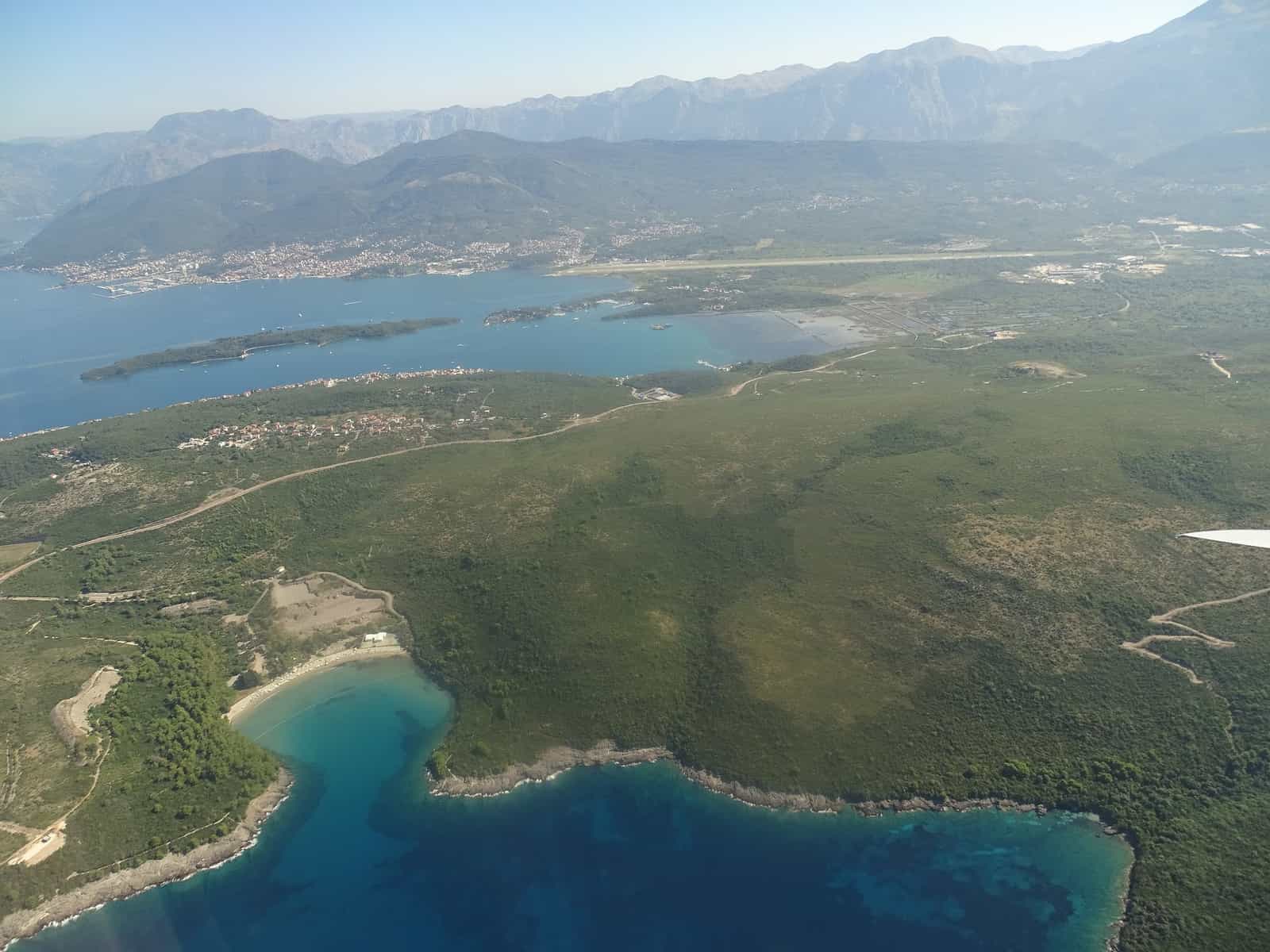
Travelling to Montenegro with a drone
Photo: Ad Meskens · CC BY-SA 4.0

If you are registered and exam-certified as a drone operator in an EU member state, you fly in Montenegro on those papers: no local registration, no local exam. Carry proof of the exam, your registration number and an insurance policy valid in Montenegro or the EU. Operators from outside the EU register in Montenegro unless their home system is recognised. Batteries go in hand luggage, never in the hold. An import approval from the Ministry of Economic Development, a €10 form, is still on the books for foreigners too; whether a holidaymaker's own drone is checked for it is an open question. Rules can change, so check the Civil Aviation Agency's drone page before the trip.
Guides written before July 2024, and the airports' own "No Drone Zone" page, still give the 2016 limits (registration from 0.5 kg, 150 m height, 500 m range, a night ban). The current rules are on the drone rules page: registration from 250 g or any camera drone, 120 m, EU-style classes.
Registered in the EU
An operator registered and exam-certified in an EU member state needs neither to register nor to sit the exam in Montenegro. The Civil Aviation Agency (CAA) took that position in July 2024, and the 2026 Law on Air Traffic (Art. 98) has written it into law: EU-issued operator registrations, pilot certificates and approvals are recognised for the period they were issued for. Carry proof of the exam and your registration number or statement, and put your EU operator number on the drone as you would at home.
Specific-category operators with an EU operational authorisation apply to the CAA before flying, with a copy of the authorisation, the locations and risk mitigation and proof of insurance, and fly only after approval. An operator flying under a declared standard scenario sends the CAA a copy of the declaration and its acknowledgement. This procedure (amendment 75/25) applies until Montenegro joins the EU.
Registered outside the EU
Under the 2026 law, operator registrations and certificates from a third country are recognised if they were issued under the same conditions as in Montenegro; an operator registered neither in the EU nor under equivalent rules registers in Montenegro's register at dron.caa.me. Which systems count as equivalent (the UK CAA, the US FAA and others) is not set out and there is no list of recognised countries, so a visitor from outside the EU writes to dron@caa.me before the trip or plans to register on arrival. The CAA may charge a recognition fee; ask about it when you write.
Documents to carry
- Operator registration number or statement (EU, or Montenegrin from dron.caa.me).
- Pilot certificate: proof of the A1/A3 exam, plus the A2 certificate for a C2 drone in A2 operation.
- Third-party liability insurance valid in Montenegro or the EU. The CAA requires it under the Law on Compulsory Traffic Insurance; no minimum sum is set.
- Passport or ID.
- For a flight above 50 m in the Podgorica or Tivat control zones, or in the 4 km core areas: the AMC Montenegro approval, requested at least two working days ahead.
- In a national park: the Environmental Protection Agency permit, the CAA document for a drone over 249 g and the parks company's approval.
Municipal police in Tivat and Kotor may stop a pilot and check registration and certificates under agreements with the CAA (Tivat from 21 October 2025, Kotor by 7 November 2025), so keep these papers on your phone or in the drone bag.
The Ministry import approval
Bringing a drone into the country still needs an approval from the Ministry of Economic Development, and that applies to foreigners too, including those registered in the EU: this is the CAA's position of July 2024. The Government's own page of August 2023, now archived, lists the application: a passport copy, the drone's technical specification, proof of the administrative fee and the foreign-trade application form.
The Ministry's form, issued under Articles 19 and 22 of the Law on Foreign Trade, asks for the drone's serial number, weight and payload, the period and purpose of use, and a passport copy. The fee is €10, paid to account 832-3161232-94 with the purpose "DOZVOLA ZA UVOZ", and a permit is valid for up to one year. The form still cites the repealed 2016 rulebook, the Government page is archived, the ministry is named three different ways across the documents, and there is no official processing time. Whether this approval is still required or checked for a tourist bringing a personal drone on holiday is therefore an open question; the CAA's 2024 statement is the latest official word. The Customs Administration gives no guidance on drones for travellers, and the land borders with Croatia, Bosnia and Herzegovina, Serbia, Kosovo and Albania have no rule of their own beyond this approval. If in doubt, ask the CAA (dron@caa.me) before travelling; the Ministry form is the documented route.
Flying in: batteries
Items containing lithium batteries must not go in checked baggage at Podgorica Airport: carry them in hand luggage, and check the CAA's prohibited-items list and your airline. Under the IATA guidance, spare batteries and power banks go only in hand baggage, protected against short circuit; up to 100 Wh is generally allowed, 100-160 Wh may be allowed with the airline's approval (the IATA page names cameras and drones), and over 160 Wh is usually not accepted on passenger aircraft. The Wh figure is printed on the battery. Airport pages: Podgorica and Tivat.
Which drone to bring
A C0 drone under 250 g is the simplest: it flies in A1 over uninvolved people (never over crowds), needs no exam, and the operator registers only if it has a camera and is not a toy. A drone without a C class label flies under transitional rules until 11 January 2027 (under 500 g as A1; under 2 kg with A2-level competence and 50 m from people; under 25 kg as A3). After that date an unlabelled drone flies only as A1 under 250 g, as A3 under 25 kg, or in the specific category.
Where you can and cannot fly
In short: below 120 m, in sight, never over an assembly of people (the CAA counts a sunny beach, a busy shopping street or a ski slope as one); not inside the 4 km core areas at Podgorica and Tivat airports; at most 50 m above ground in the rest of the two control zones, including the part of the Tivat zone over Kotor; in the national parks only with the two permits and the parks company's approval. No other no-fly zone exists in the published airspace information. The full rules, the airport approval procedure and the fines are on the drone rules page.


Common questions
I am registered as a drone operator in the EU. Do I need to register in Montenegro?
No. EU-registered and EU-certified operators fly on their home papers, and the 2026 law recognises EU certificates for their validity period. Carry proof of the exam, your registration number and insurance valid in Montenegro or the EU.
I am from the UK or the US. Can I fly my drone in Montenegro?
Third-country registrations are recognised only if issued under the same conditions as in Montenegro, and there is no list of recognised countries. Write to dron@caa.me before the trip or register at dron.caa.me.
Do I need an import permit for my drone?
An approval from the Ministry of Economic Development is still required under the CAA's 2024 position, including for EU-registered visitors. The form costs €10 and the permit is valid up to one year. The form and Government page are out of date, so whether it is enforced for tourists is an open question.
Can I put the drone in checked luggage?
Not the batteries. At Podgorica Airport items with lithium batteries go in hand luggage. Under IATA guidance, batteries up to 100 Wh are generally allowed, 100-160 Wh with the airline's approval, and over 160 Wh usually not at all.
Do I need insurance?
Yes. The CAA requires third-party liability insurance, and a foreign operator's policy must cover Montenegro or the EU. No minimum sum is set.
Related
Sources
- Zakon o vazdušnom saobraćaju, Sl. list CG 52/2026 (17.4.2026, in force 25.4.2026), Arts. 98 and 100
- CAA, Pilot examination and registration of drone operators (25.7.2024)
- CAA, Polaganje ispita za pilote i registracija operatora dronova (23.7.2024)
- CAA, Pravilnik o uslovima za sigurnu upotrebu sistema bespilotnih vazduhoplova, Sl. list CG 24/23
- CAA, Pravilnik o izmjenama Pravilnika, Sl. list CG 75/25 (10.7.2025), EU specific-category operators
- CAA, Pravilnik o izmjeni Pravilnika, Sl. list CG 73/26 (27.5.2026, transition to 11.1.2027)
- CAA, Kako vršiti operacije dronovima u otvorenoj kategoriji (guide by class)
- CAA, Uslovi izvođenja operacija dronovima koji nemaju C oznaku (25.7.2025)
- CAA, Izvođenje letova dronovima u blizini ljudi
- CAA drone portal (registration and exam)
- CAA, Safety Order 2017/001 rev. 03, UAS operations in CTR Podgorica and CTR Tivat (1.7.2024)
- CAA, agreement with Kotor on illegal drone use (7.11.2025)
- SMATSA eAIP, AIRAC of 29.10.2026, ENR 5.1 and ENR 5.3 (Montenegro: NIL); current edition via the start page
- National Parks of Montenegro, Pravila o snimanju, fotografisanju i upotrebi drona u NPCG (1.7.2026)
- Gov.me, Uvoz i korišćenje bespilotne letilice u Crnoj Gori (29.8.2023, archived)
- Ministry import application form (Law on Foreign Trade, Arts. 19 and 22), €10 fee
- Montenegro Airports, No Drone Zone (outdated 2016 rules)
- Montenegro Airports, Aerodrom Podgorica: procedure na aerodromu (lithium batteries)
- IATA, Travelling with lithium batteries