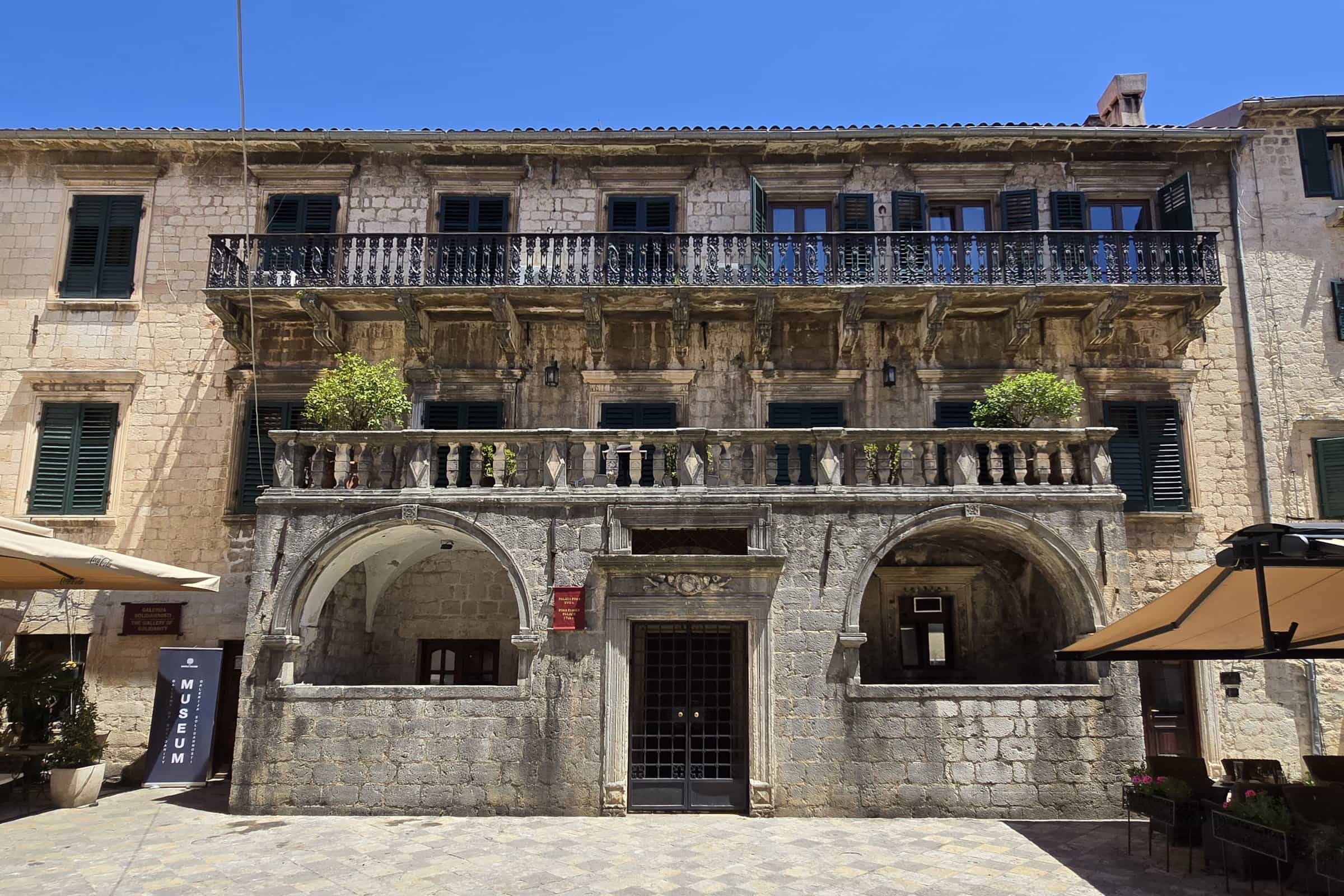
Gallery of Solidarity, Lapidarium and St Paul's Church, Kotor
Three Muzeji Kotor sites in the Old Town on one €6 ticket: the Gallery of Solidarity in the Pima Palace (736 works given after the 1979 earthquake), the Kotor Lapidarium in St Michael's Church and St Paul's Church of 1263. Summer Tuesday-Sunday 10:00-16:00.
Cultural Center · Kotor
Photo: Rigorius · CC BY-SA 4.0
The Gallery of Solidarity, the Kotor Lapidarium in the Church of St Michael and St Paul's Church are three small museum sites in Kotor Old Town, run by Muzeji Kotor and seen on one ticket of €6 (children up to 12 and groups of 10 or more €4). The gallery shows art given to Kotor after the 1979 earthquake, the lapidarium the town's stone sculpture from a 1st-century portrait of Domitian to Venetian coats of arms, and St Paul's is a church of 1263 with its founders' tomb. From 15 May to 15 October all three are open Tuesday to Sunday 10:00-16:00; in winter only the gallery is open, on weekdays 09:00-16:00, and the two churches by prior arrangement. The gallery is 140 m from each of the two churches, which are 190 m apart.
- What An art collection of 736 works given after the 1979 earthquake, the stone-sculpture collection of Kotor, and a 13th-century church with a medieval tomb
- Ticket €6 for the three sites; children up to 12 and groups of 10 or more €4; €15 for all five Muzeji Kotor sites
- Summer hours 15 May-15 October, Tuesday-Sunday 10:00-16:00, all three sites
- Winter Gallery on weekdays 09:00-16:00, closed all January; Lapidarium and St Paul's by prior arrangement
- Where Pima Palace on Flour Square (gallery), St Michael's near the old cinema, St Paul's behind the cathedral apse
Tickets and hours
One ticket covers the Gallery of Solidarity, the Lapidarium and St Paul's: €6, or €4 for children up to 12 and for groups of 10 or more. The combined ticket for all five Muzeji Kotor sites, which adds the Perast Museum and the Roman mosaics in Risan, costs €15. Residents of the Municipality of Kotor, primary school pupils from Montenegro, people with disabilities, accredited tourist guides and ICOM card holders enter free; secondary school pupils and pensioners from Montenegro, students with a student card and journalists with a press card pay €4. Photography is not allowed without special approval.
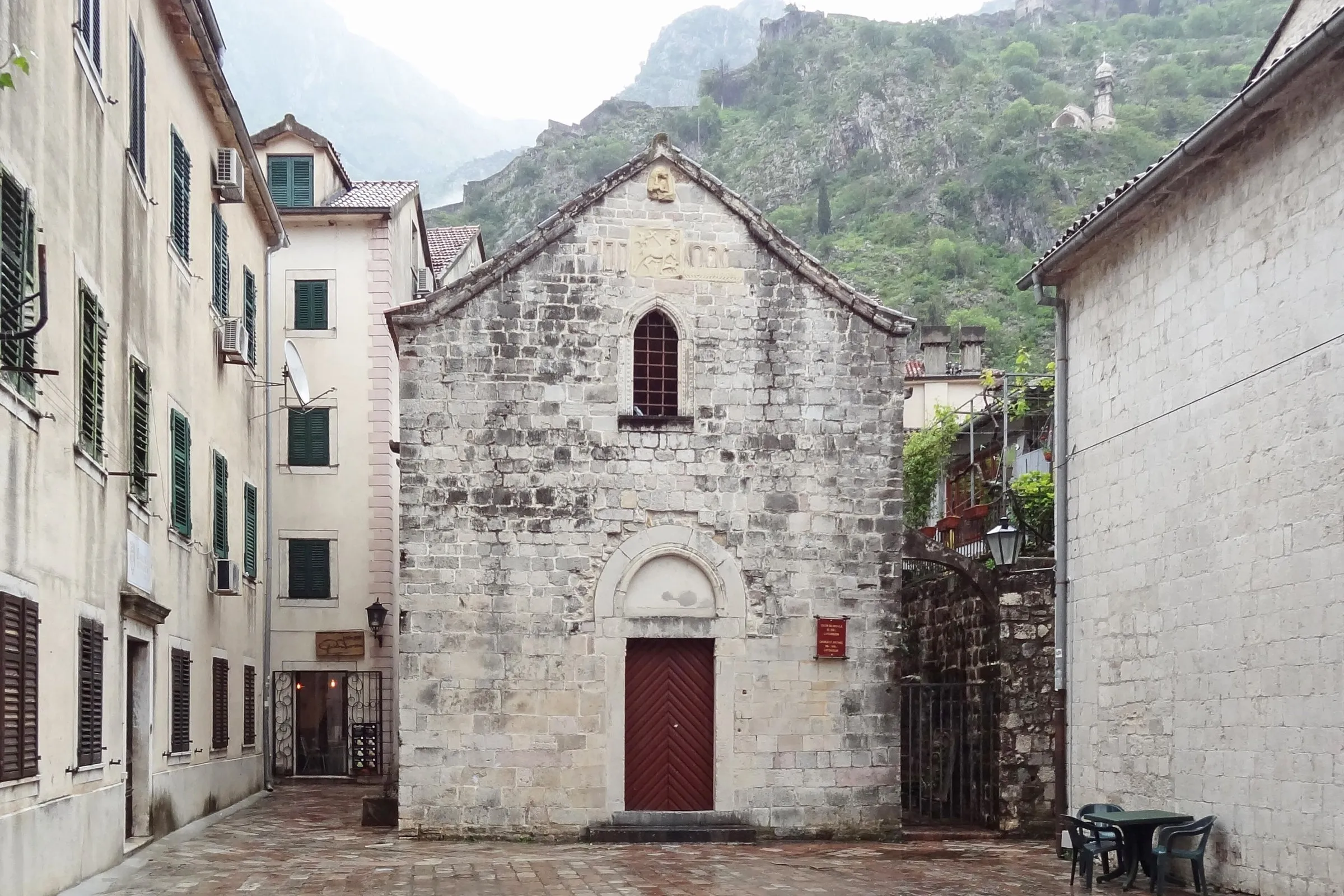
From 15 May to 15 October all three sites are open Tuesday to Sunday 10:00-16:00 and closed on Mondays, at Easter and on 1 May. From 15 October to 15 May the Lapidarium and St Paul's are closed and can be visited by prior arrangement with the museum, while the Gallery of Solidarity keeps weekday hours of 09:00-16:00 and closes for the whole of January.
Good to know: The museum lists the gallery's winter days as Monday to Friday and at the same time says it is closed every Monday, so check Monday locally in winter.
Gallery of Solidarity
After the earthquake of 15 April 1979, artists' associations across former Yugoslavia collected works of art and gave them to Kotor, with contributions from artists in the USA, Poland and Romania as well. Most works date from the 1970s, in oil, acrylic, tempera, drawing, prints, serigraphy and sculpture. A gallery space fitted out on the Square of Arms in 1980 never really came to life, and for years the collection moved around: the Town Hall, a basement that flooded several times, from 1998 a room in the Perast Museum and from 2006 a new store there. Between 1992, when it became a unit of the newly founded Muzeji Kotor, and 2011, fourteen thematic exhibitions showed almost the whole collection.
On 21 November 2011, the Day of the Municipality of Kotor, the gallery got its permanent home on the ground floor of the Renaissance-Baroque Pima Palace on Flour Square (Pjaca od brašna): three exhibition rooms and a store. The original fund is 372 works (paintings, prints, drawings, mosaics, serigraphs, sculptures, tapestries and art photographs); with later gifts the total is 736, including 437 donated works and 299 left by the painter Gojko Crnčević. The sub-collections to look for are the Slovenian prints, the naive art and Cata Dujšin-Ribar's Montenegrin cycle. A monograph and the permanent display were presented in May 2022.
The Lapidarium in St Michael's Church
Kotor's collection of stone sculpture is among the richest in Montenegro. It began in 1906 with fragments found during the 1896-1907 works on the Cathedral of St Tryphon; the Boka Antiquities Society (1906-1914) set up a small museum-lapidarium in the former church of Our Lady of the Rosary, where it stayed until the end of the Second World War. After 1945 it moved several times; after the 1979 earthquake the large pieces went to the plateau above the North Gate, the smaller ones to the Gurdić bastion and then to the abandoned St Paul's, and the pre-war records were destroyed. Since 2004 it has been in St Michael's, open to the public.
On show are a portrait of the Roman emperor Domitian (1st century AD), cone-shaped Illyro-Roman tombstones (cippi) of the 2nd and 3rd centuries, early Christian fragments with an Agnus Dei relief, partly reconstructed pre-Romanesque church furniture, capitals from Roman to Baroque, and the coats of arms of Venetian governors and of old Kotor and Perast families: Pezzi, Beskuća, Drago, Paskvali, Magno, Bollini, Bembo, Buća, Bizanti, Vrakjen, Contareno and Visković. The church is small, so only part of the collection fits; the rest is spread over St Paul's (since 2017), the cathedral, the Maritime Museum, St Mary's, the Perast Museum and the islet churches off Perast.
The building is worth the visit on its own: a Romano-Gothic single-nave church of the late 13th or early 14th century, built over an early Romanesque church named in the cathedral's consecration charter of 1166, which itself stood on what was probably a three-aisled early Christian basilica of the 6th century, excavated in the 1980s. A bell-cote with two bells was added over the west door in the mid-15th century. The apse has mid-15th-century frescoes attributed to Lovro Dobričević of Kotor: a Deesis with Christ Pantocrator, the Ascension and St Tryphon holding a model of the town, with a damaged St George on the south wall and older fragments of saints, up to about 70 cm high, in the earlier apse. In the early 19th century French troops used the church as a store and split it with a floor; it was restored to its original form in 1980-1989.
St Paul's Church
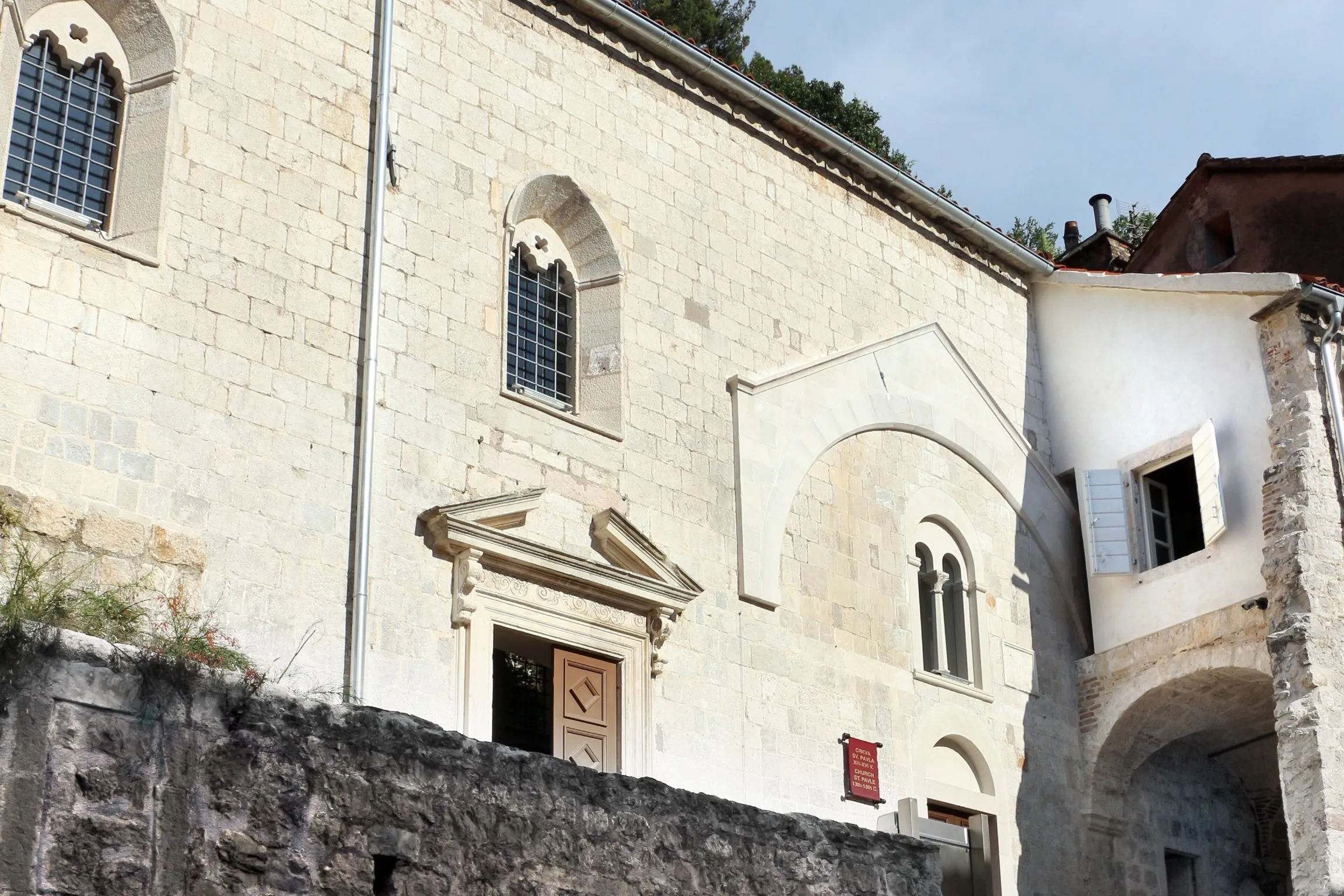
St Paul's stands behind the apse of the cathedral, at the foot of St John's hill, on the old main street between the North and South gates; for a long time a high wall hid everything but its Romano-Gothic portal. A citizen of Kotor, Pavle Bari, built it in 1263 as his legacy; the inscription on the front names the Serbian king Uroš I, Pope Urban IV and Bishop Marko of Kotor. The founder's inscription dates it to 1263. A Dominican monastery stood next to it, first for men and from the 16th century for nuns.
The church has had hard uses. Under Napoleonic rule (1807-1814) it was a barracks split into two floors, under the Italian occupation in the Second World War a prison, and from 1948 a women's prison, the Little Prison. Research showed that it was enlarged in the 16th century: of the 13th-century church only part of the west front with the portal and inscription survives, with the foundations of the side walls and a diagonal chessboard stone floor, now on show inside. An arcosolium, an arched medieval tomb, holds a stone sarcophagus with the remains of the founders, Pavle Bari and his wife Dobra; 13th-century fresco remains include a well-preserved St Paul and a Deesis with the Virgin and Child. Today the church is a museum space for part of the lapidarium and a hall for exhibitions, concerts and meetings.
Blessed Osanna of Kotor: Her anchoress cell is in St Paul's, where she died, walled in, in 1565. Born on 25 November 1493 in Relezi near Cetinje to an Orthodox family, she came to Kotor at 14 in 1507, served in the Buća household and joined the Dominican third order on 25 January 1515. She is remembered for encouraging the defenders during Hayreddin Barbarossa's siege of August 1539. She died on 27 April 1565; Pope Pius XI allowed her veneration on 20 December 1927, and since 24 June 1930 her body has rested in a sarcophagus by Antun Augustinčić in St Mary's Church.
Getting there
The Old Town is pedestrian. From the centre of Kotor Old Town the Gallery of Solidarity is 120 m (1 minute on foot), from the Cathedral of St Tryphon 90 m. From the gallery it is 140 m (2 minutes) to St Michael's and 140 m to St Paul's, and the two churches are 190 m apart. Parking is covered on the Kotor page.
Nearby
- Cathedral of St Tryphon, 90 m, 1 minute on foot.
- Maritime Museum of Montenegro, 140 m, 2 minutes.
- Church of St Luke, 190 m, 2 minutes.
- Church of St Nicholas, 240 m, 3 minutes.
- Kotor Old Town, the walls, gates and squares around all three sites.
- Perast Museum and Roman mosaics in Risan, the other two Muzeji Kotor sites on the €15 ticket.
- More museums on the museums page.
Questions
How much is the ticket for the Gallery of Solidarity and the Lapidarium in Kotor?
The Gallery of Solidarity, the Lapidarium and St Paul's share one ticket of €6, €4 for children up to 12 and for groups of 10 or more, and a €15 ticket covers all five Muzeji Kotor sites.
When is the Kotor Lapidarium open?
The Kotor Lapidarium in St Michael's Church is open from 15 May to 15 October, Tuesday to Sunday 10:00-16:00, and in winter by prior arrangement with the museum.
What is in the Gallery of Solidarity in Kotor?
The Gallery of Solidarity in Kotor holds 736 works, most of them given by artists across former Yugoslavia after the 1979 earthquake, shown in three rooms of the Pima Palace on Flour Square.
When was St Paul's Church in Kotor built?
St Paul's Church in Kotor was built in 1263 by Pavle Bari, as the inscription on its front records.
More museums
Nearest by road first


Sources
Muzeji Kotor, Ulaznice (prices valid from 1 January 2025: fees €6/€4/€15, free entry and €4 groups, groups of 10 or more, hours by season, closures) · Muzeji Kotor, Galerija solidarnosti (holdings 372, 736, 437 and 299, monograph and permanent display May 2022) · Muzeji Kotor, Admission fees and renting (English fees page: ICOM card holders free, photography rule, €15 common ticket) · Muzeji Kotor, Gallery of Solidarity (origin after 1979, techniques, 1980 space, moves, exhibitions 1992-2011, Pima Palace 21 November 2011) · Muzeji Kotor, Lapidarium (collection history from 1906, moves after 1979, in St Michael's since 2004, exhibits, coats of arms, items elsewhere) · Muzeji Kotor, Church of St Michael (building history, 1166 charter, 6th-century basilica, bell-cote, Dobričević frescoes, French store, restoration 1980-1989) · Muzeji Kotor, Saint Paul's Church (1263, Pavle Bari, inscription, Dominicans, barracks, prisons, 16th-century enlargement, chessboard floor, uses today) · Muzeji Kotor, Tomb of the founder of Saint Paul's Church (arcosolium, sarcophagus of Pavle Bari and Dobra, 13th-century frescoes) · Muzeji Kotor, Blessed Osanna of Kotor (dates, Buća household, 1539 siege, 1927 veneration, 1930 sarcophagus in St Mary's) · Muzeji Kotor, MPI Muzeji Kotor (founded 1992, units, Pima Palace) · OpenStreetMap node 9282711882, way 197926377 and way 197926383, ODbL · OSRM routing (OpenStreetMap data, ODbL)