Cervantes monument, Ulcinj
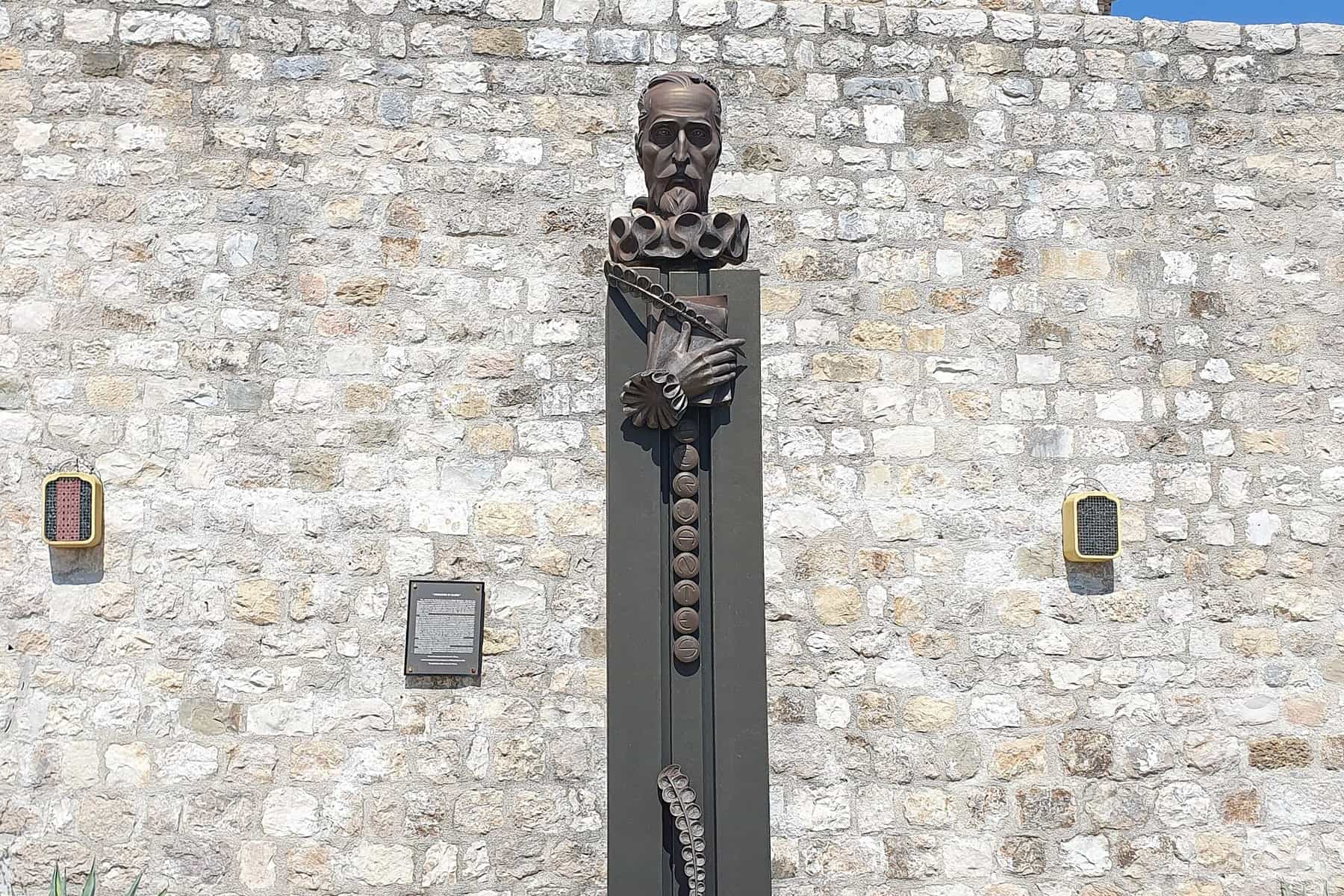
Bujar Vani's bronze bust of Cervantes on a pillar in Ulcinj Old Town, marking the legend of the writer's captivity here
Bronze bust on a pillar · Commissioned under the 2018 programme · Ulcinj Old Town
The Cervantes monument in Ulcinj is a tall dark pillar topped by a bronze bust of the writer, ruff at the neck and a quill in his hand, in the Old Town near the Palata Venezia hotel, with an information plaque on the wall of the stone house behind it. It is the work of the sculptor Bujar Vani, who won the Ulcinj Tourist Organisation's competition for a sculpture called "Cervantes and Dulcinea". It marks a legend rather than a documented event: the tradition that Miguel de Cervantes spent part of his captivity as a slave in Ulcinj at the end of the 16th century. The monument is open-air and free to see.
Where it is
The statue stands inside the walled Old Town on the hill above Mala plaža, reached on foot up steps from the harbour side. The square in the Old Town is Trg robova, Slave Square, also called Cervantes Square; it is bordered by the casemates opposite the church-mosque and the Balšić Tower. Tradition places the slave market here and says Cervantes was held in one of the casemates. Drive times without traffic to Ulcinj: Bar 32.2 km, about 42 minutes; Podgorica 81.2 km, about 1 hour 45 minutes.

The competition and the sculptor
The Ulcinj Tourist Organisation ran a competition for a sculpture of "Cervantes and Dulcinea". A jury of Qazim Muja, Nail Draga and Mehmet Aloja gave first prize to Bujar Vani, second to Evis Kabilo and third to Agron Ujkashi, and production of the winning design was put into the organisation's 2018 programme. The pillar and bust that stand in the Old Town are Vani's work.
The legend of Cervantes in Ulcinj
In 1575 Cervantes was captured at sea by corsairs and spent five years as a slave until his ransom in September 1580. The documented place of his captivity is Algiers. Ulcinj tradition tells a different version: that the corsair ships that took him were from Ulcinj, under the captain Arnaut Mami, and that the writer was held in the town's casemates. In local memory he is "Servet", the slave who wrote by night and sang by day; a girl of the town is said to have followed him when a stranger paid his ransom, and some connect the name Dulcinea with "Ulcinjanka", a woman of Ulcinj. The ransom is given as 500 gold thalers, part of it raised by his father selling property.
Cervantes himself never wrote that he was in Ulcinj, and there is no clear evidence that he was. The town treats the story as what it is, a legend, and tells it alongside that of another famous exile, Sabbatai Zevi, the 17th-century messianic claimant who was sent to Ulcinj and died here; a room on the third level of the Balšić Tower is linked to him by tradition, without proof.

Nearby
- Ulcinj Old Town and the Balšić Tower, around the square.
- Clock tower in the Old Town.
- Freedom Monument.
- Mala plaža, the town beach below the walls.
- Ulcinj, the town page, with Velika plaža and Ada Bojana to the south.
History
1575-1580
The captivity
Cervantes is captured at sea in 1575 and ransomed in September 1580; the documented place is Algiers, Ulcinj tradition claims the town's casemates.
2018
Competition and monument
The Ulcinj Tourist Organisation's jury (Qazim Muja, Nail Draga, Mehmet Aloja) gives first prize to Bujar Vani; production is put into the 2018 programme.
Sources
Ulcinj Tourist Organisation, Servantes i Dulcinea (competition, jury, 2018 programme) · Ulcinj Tourist Organisation, Miguel de Servantes (the legend: 1575, Arnaut Mami, September 1580) · Ulcinj Tourist Organisation, Stari grad · Wikimedia Commons, 2023 Cervantes monument in Ulcinj (photo, 21 Aug 2023, CC0; credits Bujar Vani) · UL-info, S. Adrović: Servantes i Ulcinj (Trg robova, casemates, ransom, no evidence) · Portal Analitika, Slavni ulcinjski robovi i izgnanici: Servantes i Sabataj Cevi · Foodbook, Stari grad Ulcinj kao Servantesova inspiracija (location by the Palata Venezia hotel) · OpenStreetMap node 778101816, Palata Venezia, Ulcinj, ODbL · OSRM routing (car and foot, OpenStreetMap data, ODbL; times without traffic)