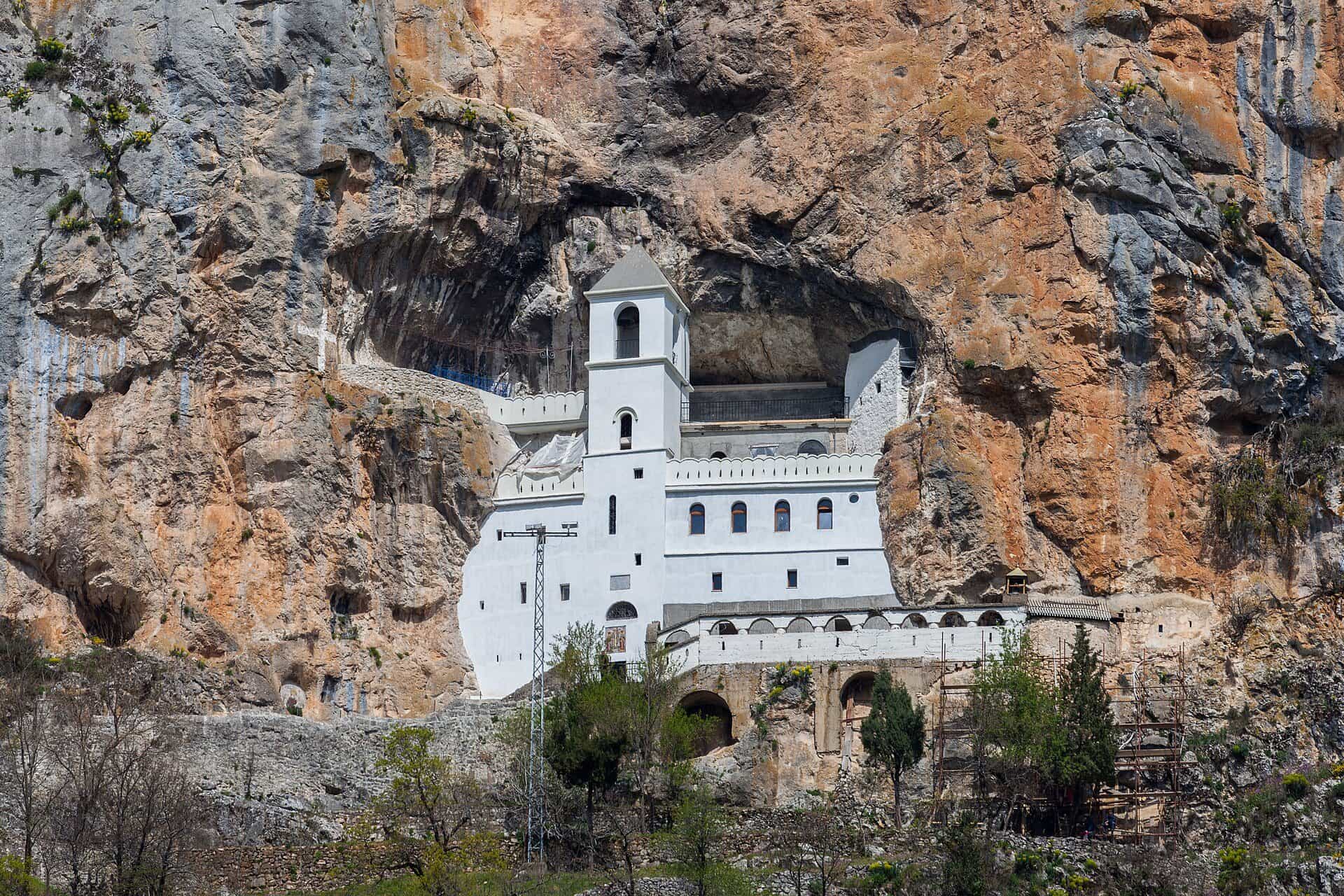
Ostrog Monastery
Monastery of St Basil of Ostrog built into the cliff of Ostroška greda, at about 900 m above sea level, high above the Zeta valley
Orthodox monastery · Ostroška greda cliff above the Zeta valley
Photo: Diego Delso · CC BY-SA 3.0
Ostrog is the monastery of St Basil (Sveti Vasilije) of Ostrog, built into the cliff of Ostroška greda in Danilovgrad municipality, at about 900 m above sea level, high above the valley of the Zeta. It is the most visited of Montenegro's monasteries and one of the most visited in the Orthodox world. People of every faith come to pray at the saint's relics, which rest in a cave church cut into the rock. The monastery has two parts: the Lower monastery on a wide terrace, where the road arrives, and the Upper monastery in the cliff, about 3 km above it on foot or 2 km by a steep, narrow road.
Ostrog Monastery tours
Sponsored Ostrog monastery and Skadar Lake from PodgoricaRating 4.8 (28)from €125
 Book Your Tour Ostrog MonasteryRating 3.5 (4)from €65
 Ostrog Monastery tourRating 4.9 (37)from €119
 Private Tour in Ostrog Monastery, Doclea and Nature Park ZetaRating 4.9 (23)from €100
Tours, ratings and prices: Viator.
All tours in Ostrog MonasteryUpper and Lower monastery
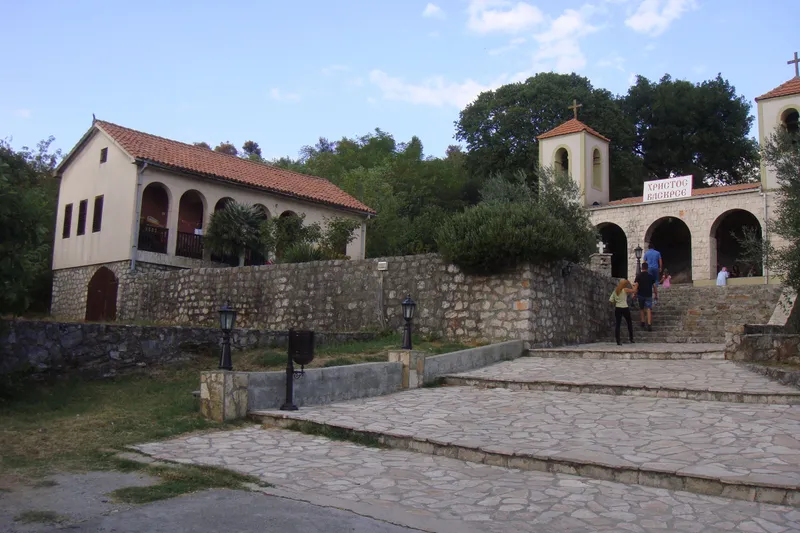
The Lower monastery stands around the Church of the Holy Trinity, built in 1824, on a broad terrace with the guest house, the parking and the start of the pilgrims' path. The Upper monastery is the one in every photograph: a white facade pressed into a near-vertical wall of rock, with two cave churches behind it. The Church of the Entry of the Theotokos (Vavedenje) holds the relics of St Basil in front of the iconostasis; the Church of the Holy Cross, with its old vine, sits higher in the cliff. Both have 17th-century frescoes painted straight onto the rock. From the Upper monastery the view opens over the Bjelopavlići plain and the Zeta valley.
The story told at Ostrog is that in 1942, during the Second World War, an artillery shell struck the rock above the Upper monastery, broke the door of the small Church of the Holy Cross, did not explode and broke in two. Pilgrims count it among the miracles of St Basil, and the monastery keeps the shell to this day.

The walk from the Lower to the Upper monastery
Most pilgrims leave the car at the Lower monastery and walk. The forest path climbs about 3 km and takes no more than half an hour at a steady pace. By road the two parts are 2.1 km apart, about five to ten minutes by car, but the last stretch climbs at 10 %, is very narrow and is busy in both directions. Large campers and motorhomes stop at the Lower monastery; for everyone else the sensible choice is to leave the vehicle there and take the path.

Visiting, services and baptisms
Ostrog is a working monastery and a place of pilgrimage, not a museum, so dress and behave as you would in any church. The monastery's own phone, +382 68 800 899 (manastirostrog@gmail.com), is the place for questions about services and visiting. Baptisms are held every day at 10:00, 12:00 and 14:00 in the Church of St Stanko the New Martyr; arrangements go through ostrogkrstenica@gmail.com. On Krstovdan, the Exaltation of the Cross on 27 September, the liturgy at the Upper monastery is served by the Metropolitan of Montenegro and the Littoral.
Can you sleep at Ostrog?
Yes. The monastery runs a large guest house (konak) at the Lower monastery, reached on +382 68 080 133, and many pilgrims stay the night there. When it is full, people spend the night on the terrace in front of the church.
St Basil of Ostrog
Stojan Jovanović was born in Mrkonjići in Popovo polje, Herzegovina, by some accounts on 28 December 1610. Known as the monk Vasilije, he died in his cell at Ostrog on Saturday of Bright Week, 12 May 1671. He was buried on the terrace below the Vavedenje church. Seven years later the monks opened the grave, found the body incorrupt and placed it in the Vavedenje church, where it has remained. The relics are the reason most visitors come, Orthodox and otherwise.
History
The name Ostrog is first written down long before the monastery: in charters of King Alfonso V of Naples from 1444 and 1454, and in Mavro Orbini's Kingdom of the Slavs of 1601. The monastery itself grew in the early 17th century from the hermit caves of St Isaiah of Ostrog and his companions, with St Basil's blessing, and the cave churches were frescoed in that century. The Lower monastery's Church of the Holy Trinity followed in 1824. On 1 June 1923 a fire destroyed much of the complex; the monastery was rebuilt between 1923 and 1926, and the buildings you see today date largely from that restoration.
Getting there
The access road leaves the Podgorica-Nikšić road at Bogetići and climbs to the Lower monastery. It is narrow, mostly asphalt with one 150 m stretch of gravel. Drive times without traffic to the Lower monastery:
- Podgorica: 37.6 km, about 1 hour
- Nikšić: 18.5 km, about 30 minutes
- Danilovgrad: 19.7 km, about 30 minutes
- Budva: 97.2 km, about 2 hours 10 minutes
- Kotor: 98.2 km, about 2 hours
From the coast, Ostrog is a full day trip: about two hours each way from Budva or Kotor, plus the walk up.
Nearby
- Danilovgrad and Nikšić, the nearest towns.
- Bedem fortress in Nikšić.
- Obadov brijeg memorial on the Podgorica-Nikšić road.
- The Zeta river in the valley below.
History
1444-1601
The name Ostrog
The name appears in charters of King Alfonso V of Naples (1444, 1454) and in Mavro Orbini's Kingdom of the Slavs (1601).
Early 17th century
From hermit caves to monastery
The monastery grew from the hermit caves of St Isaiah of Ostrog and his companions, with St Basil's blessing; the cave churches were frescoed in this century.
12 May 1671
Death of St Basil
St Basil died in his cell at Ostrog on Saturday of Bright Week and was buried below the Vavedenje church; seven years later his incorrupt body was placed in the church.
1824
Church of the Holy Trinity
The church at the centre of the Lower monastery was built.
1923-1926
Fire and restoration
A fire on 1 June 1923 destroyed much of the complex; it was rebuilt by 1926.
On these trips
- Day trips from Budva: Kotor, Cetinje, SkadarTrip 4 · Ostrog monastery
- 7 days in Montenegro: coast to Durmitor loopDay 5 · Ostrog, Nikšić and the road to Žabljak
- Day trips from Kotor: 7 trips with drive timesTrip 7 · Ostrog monastery
- Day trips from Podgorica by car or trainTrip 3 · Ostrog and Nikšić
- 10 days in Montenegro: the full loop by carDay 10 · Piva canyon, Piva monastery, Ostrog and back to Podgorica or Kotor
Sources
Ostrog Monastery official portal: history of the monastery · Ostrog Monastery official portal: life of St Basil · Ostrog Monastery official portal: baptisms · Ostrog Monastery official portal: contacts and news (Krstovdan liturgy) · National Tourism Organisation of Montenegro, Sacral objects · Ministry of Tourism, Panoramic roads guide (Ostrog section: road, campers, guest house, 1824) · OSRM routing (car, OpenStreetMap data, ODbL; times without traffic) · Večernje novosti, centenary of the 1923 fire (secondary) · Porto Montenegro blog, Ostrog Monastery (secondary; the 1942 shell story) · Kurir, St Basil of Ostrog and his miracles, 12 May 2019 (secondary; the 1942 shell story) · Monte Guide, Ostrog Monastery (secondary; the 1942 shell story)