Haj-Nehaj fortress
Ruined fortified town above Sutomore, first mentioned in 1542: a 40-minute walk up, no fee, no hours
Ruined medieval fortified town · Rocky hill between Sutomore and Maljevik
Photo: Andrija1234567 · GFDL
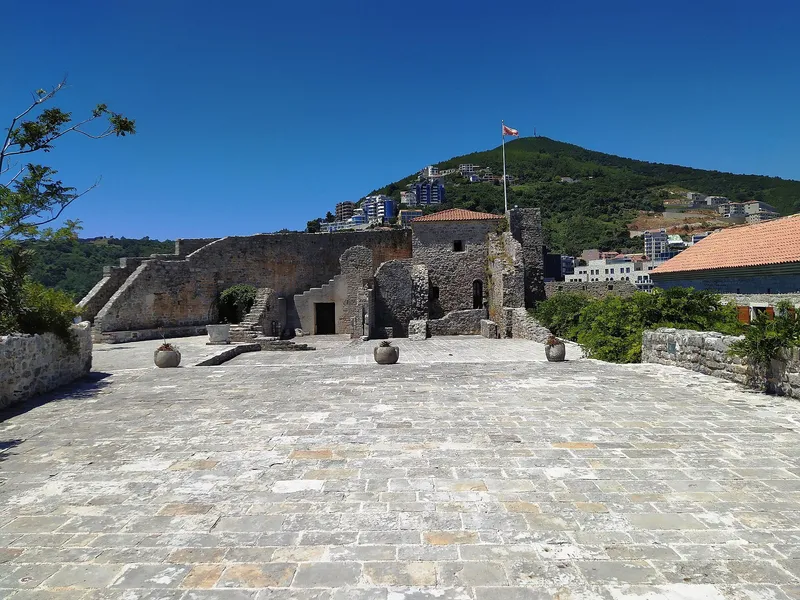
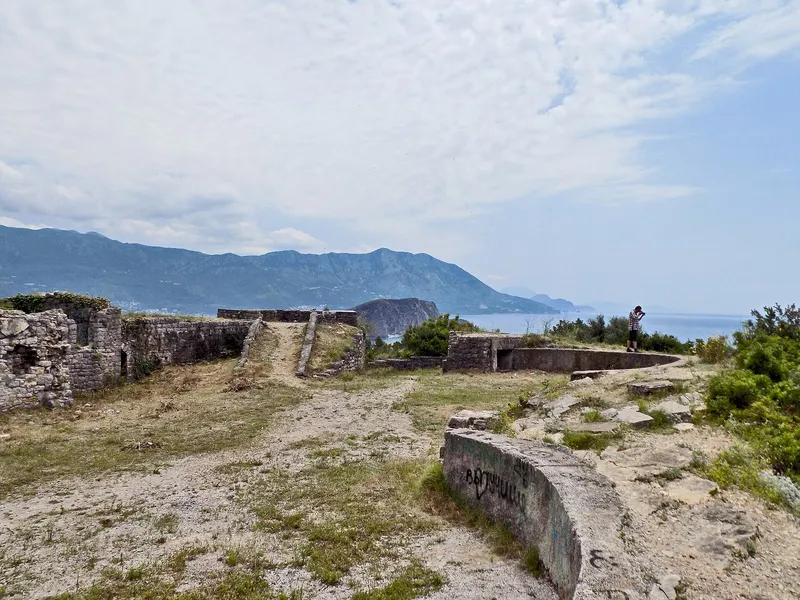
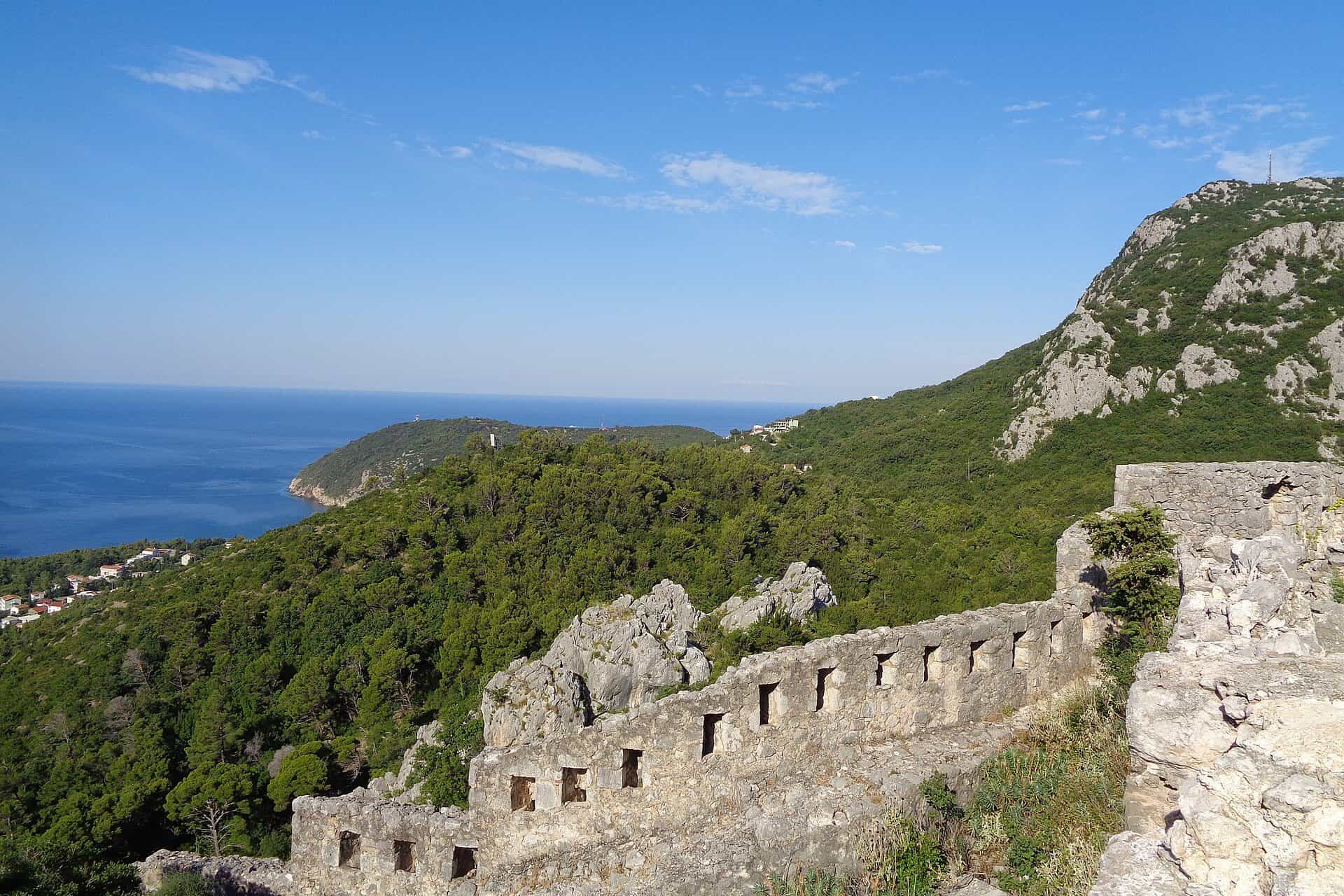
Haj-Nehaj is the ruin of the medieval fortified town of Nehaj, on a rocky hill about 225 m above the sea between Sutomore and Maljevik, about 10 km north-west of Bar. It is an open ruin: no ticket, no opening hours, no fence, reached on foot in about 40 minutes from the Maljevik road junction. First mentioned in 1542, it had a garrison of two soldiers and one gunner in 1555 and was reckoned able to shelter 900 people three years later. Inside the walls stand a small church of St Demetrius, probably older than the fortifications, and a powder magazine on the edge of the eastern cliffs.
The walk up
The path starts at the junction of the main coast road with the road down to Maljevik beach, behind a few houses, and climbs about 1 km one way with about 170 m of ascent: around 40 minutes at a steady pace, moderate, on a stony track through maquis and sparse oak wood. The hill is hard to reach from every side except the west, where the gate is, so the path brings you round to the western entrance. From the walls the view takes in Sutomore, the bay and the sea. Parking at the start is free, and the same path is the way down.
Hours and tickets
There are none. Haj-Nehaj is an unstaffed ruin with no fee, no ticket office and no gate that closes, and the parking at the foot of the path is free. Nothing is laid out for visitors: there is nobody to ask, and on the eastern side no railing between you and the drop.
What to see inside
- The entrance on the west, where three building phases can be read in the masonry, and a water cistern added later beside it.
- Round towers and gun loops. Nehaj was built for firearms: the towers are round, and many of the loops for guns were cut later.
- The church of St Demetrius (Sv. Dimitrije) on the highest point inside the walls, a small building probably older than the fortifications around it.
- The houses that fill the higher southern part and the ground by the entrance, possibly older than the northern part of the town.
- The powder magazine (barutana) at the far eastern end, above near-vertical cliffs.
History
The oldest documents call the town Haj as well as Nehaj, and the first of them dates from 1542. The fortress may be from the end of the 15th century, built by the Venetians for the defence of the coast, but no document gives the year. It appears in the upper left corner of the oldest known engraving of Bar, from 1550. A report of 1555 places it between Bar and Paštrovići with a garrison of two soldiers and one gunner; a report of 1558 reckons it could shelter 900 people if needed. The Ottoman period is usually dated from 1571 to 13 November 1877, when Montenegrin forces took the town; after 1878 it was abandoned.
Nearby
- Sutomore beach, 1,200 m of sand directly below the hill, with a station on the Bar-Belgrade railway.
- Maljevik, the cove whose access road marks the start of the path.
- Čanj, the next beach to the north-west.
- Stari Bar, the walled old town 4 km inland from Bar.
- More fortresses of Montenegro and the full list of monuments.
History
Late 15th century (?)
A Venetian fortress
Built for firearms, possibly at the end of the 15th century, by the Venetians for the defence of the coast; no document gives the year.
1542
First mention
The oldest document naming the town, as Haj or Nehaj.
1550
On the oldest engraving of Bar
Nehaj appears in the upper left corner of the oldest known engraving of Bar.
1555-1558
Two reports
A garrison of two soldiers and one gunner in 1555; room for 900 people in 1558.
1571-1877
Ottoman town
Usually dated as Ottoman from 1571 until 13 November 1877, when Montenegrin forces took it; abandoned after 1878.
Sources
Tourist Organisation Bar, Haj-Nehaj (open ruin, free parking) · Expeditio, Srednjevjekovni gradovi: Nehaj (dates, layout, church of St Demetrius) · Outdooractive, The Haj-Nehaj fortress, Sutomore (hiking route; secondary) · Montenegro for Travellers, Haj-Nehaj fortress (1571 and 1877 dates; secondary)