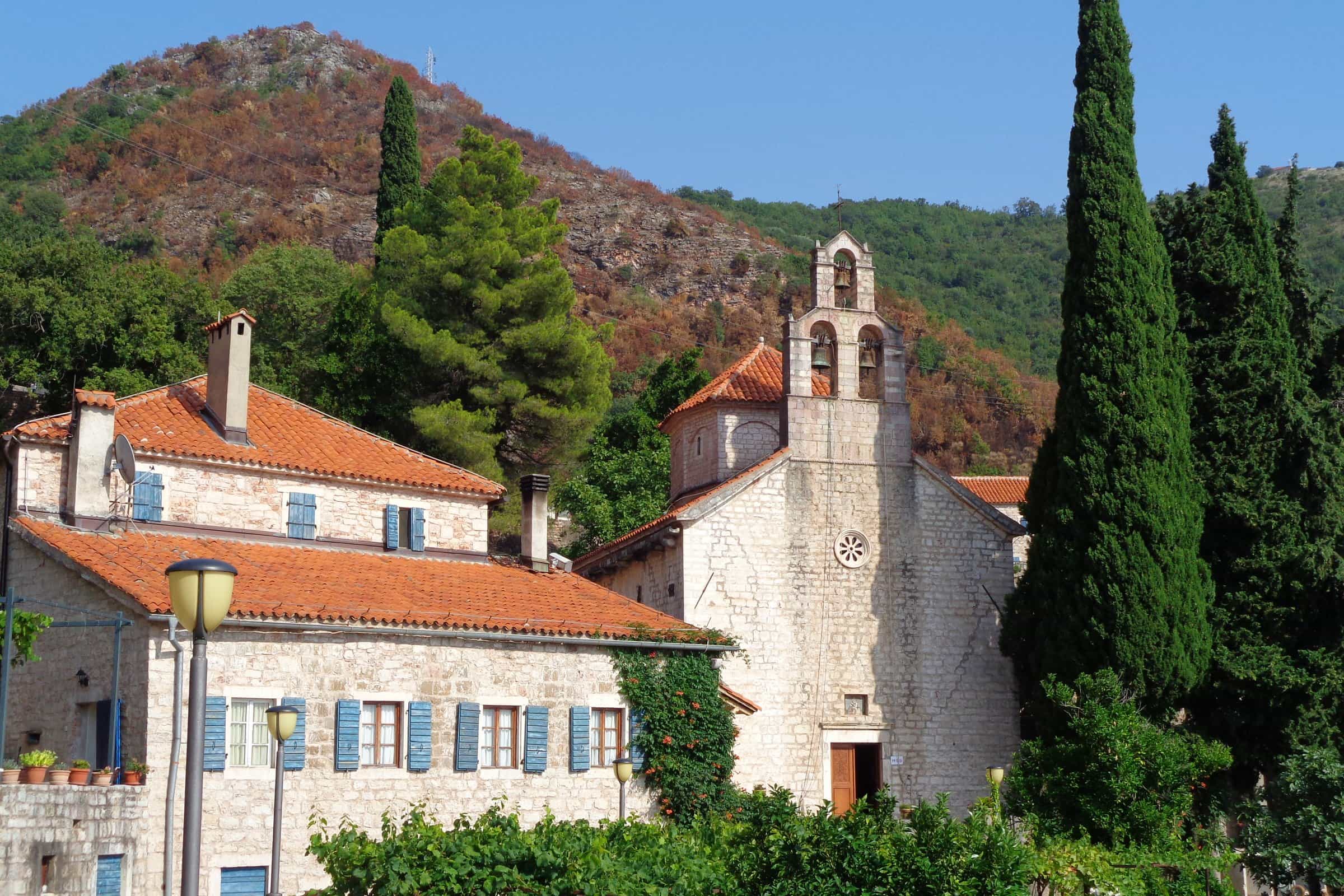
Praskvica Monastery
Orthodox monastery above Miločer and Sveti Stefan, founded in 1413 by charter of Balša III and for centuries the centre of the Paštrovići clans
Orthodox monastery with two churches · Above Miločer and Sveti Stefan
Photo: Andrija12345678 · CC BY-SA 4.0
Praskvica Monastery (Manastir Praskvica) is an Orthodox monastery of the Metropolitanate of Montenegro and the Littoral on the slope above Miločer and Sveti Stefan, in the municipality of Budva. Its founding year is taken as 1413, from a surviving charter of Balša III about building the church of St Nicholas, though local tradition holds it to be much older. For centuries it was the spiritual and political centre of the Paštrovići clans. Two churches stand here: St Nicholas, the main church, rebuilt in 1857, and the small Holy Trinity, painted in 1681. It is 1.0 km on foot from Pržno Beach and 8.9 km by road from Budva Old Town.
- Founded 1413 by charter of Balša III; first named in a charter of 1307; Holy Trinity dated to 1050 by tradition
- Churches St Nicholas (rebuilt 1857, about 20 m by 11 m) and Holy Trinity (painted 1681)
- Inside Iconostasis by Nikola Aspioti of Corfu; frescoes by the painter Radul
- Feast St Nicholas (Nikoljdan), 19 December
- Where Above Miločer: 1.0 km on foot from Pržno Beach, 8.9 km by road from Budva Old Town
The name
The name comes from a spring nearby whose water is said to smell of praskva, a local variety of peach that was once common here.
History
Praskvica is first named in a charter of 1307, in which King Milutin and his mother Jelena granted villages to the monasteries of Praskvica and Gradište. Local people hold the monastery to be far older still: the Holy Trinity church is said to date from 1050. The founding year is nevertheless taken as 1413, when Balša III, ruler of Zeta, and his mother Jelena, daughter of Prince Lazar, built the church of St Nicholas and gave it with land to the monks of Praskvica. The charter survives in an Italian copy in Kotor and in a 17th-century Church Slavonic copy.
The monastery became the spiritual and political centre of the Paštrovići, the clans of this stretch of coast; their assembly sat at the stone table of justice of Balša III. A school worked here from early times, housed in the small building called the kulica. From the mid-18th century Empress Catherine of Russia sent money to the monastery, as did Emperors Paul and Alexander I.
In 1812 French troops looted the monastery and burned the first St Nicholas church, a cross-in-square building; most of the archive of Paštrovići documents was lost with it. The present, larger St Nicholas was raised on its foundations in 1857 through archimandrite Sinesije Davidović and the Paštrovići. Six hundred years of the St Nicholas church were celebrated in September 2013, followed by a 216-page monograph on the monastery.
What you see
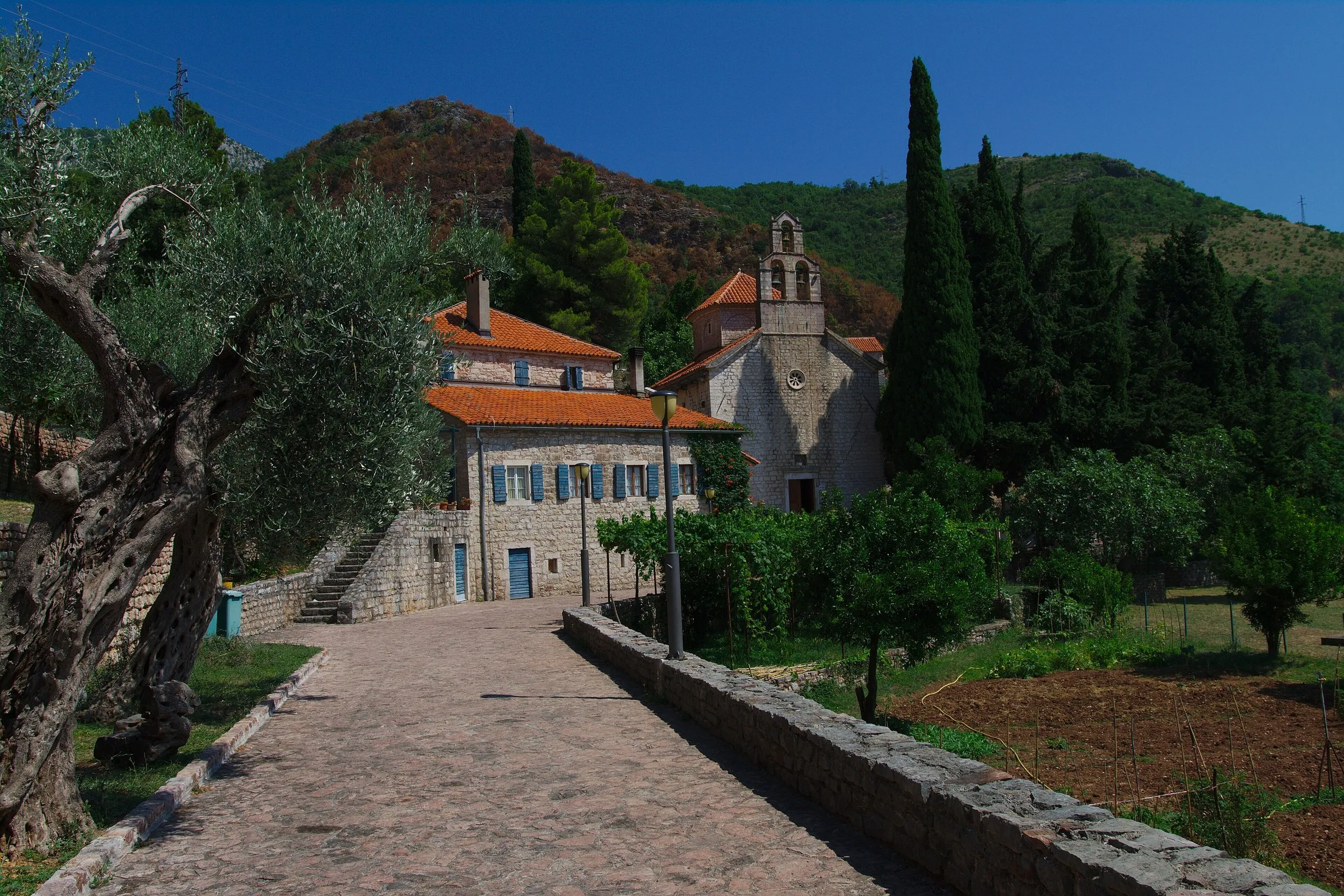
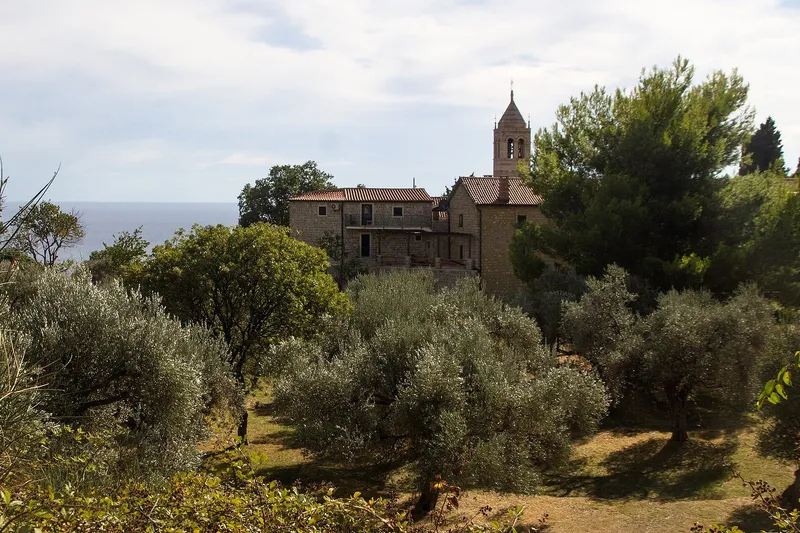
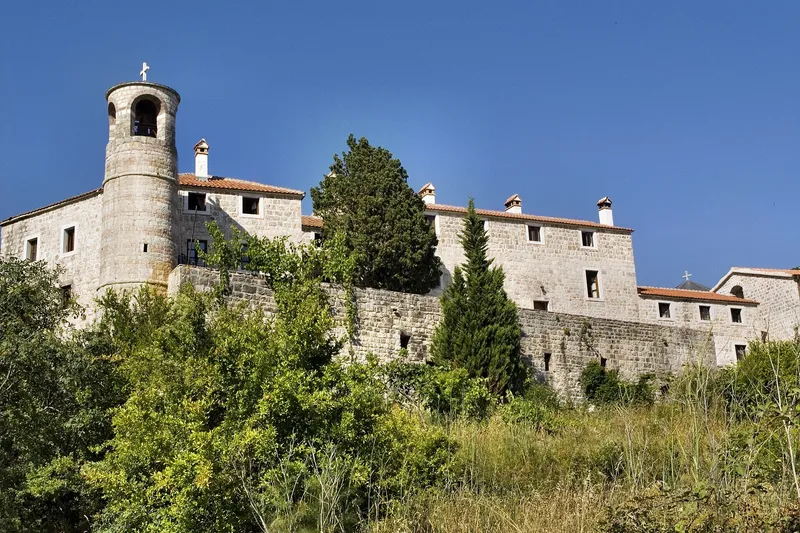
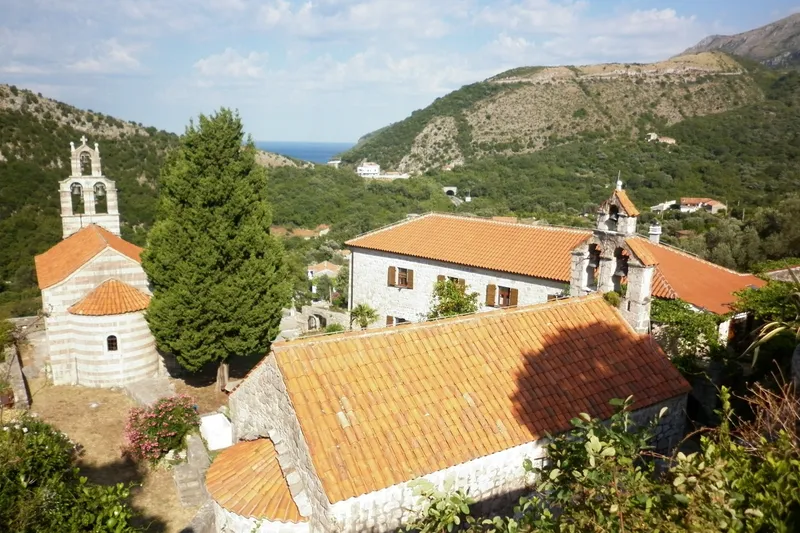
The complex has two churches, the old and the new konak (monks' lodgings) and the kulica. St Nicholas is the main church, about 20 m long and 11 m wide, standing on the foundations of Balša III's church; its iconostasis is by Nikola Aspioti of Corfu. The small Holy Trinity church was painted in 1681 and keeps frescoes by the painter (zograf) Radul; a cemetery lies beside it. In the monastery yard are the graves of Jegor and Jelisaveta Stroganov; Jegor is the monk who cut the Jegorov put, the path up to Čelobrdo.
The monastery keeps a library of about 5,000 books, an archive and a treasury. Among the items recorded in them are the icon of the Mother of God Strasna, a chalice of Emperor Paul, a deed of gift of Empress Catherine, a filigree cross of Tsar Dušan brought from Visoki Dečani, a manuscript Gospel of 1600 by Gavrilo Cetinjanin given by Bishop Danilo, the table of justice of Balša III, Paštrovići documents and old weapons. Whether any of this is shown to visitors is not published.
Visiting
Praskvica is an active monastery. Opening times, entry and rules for visitors are not published: check with the tourist office in Budva before you go. The feast of St Nicholas (Nikoljdan) is on 19 December.
Getting there and walks
On foot the monastery is 1.0 km from Pržno Beach (13 minutes), 1.1 km from Miločer Beach (14 minutes), 1.2 km from Kraljičina plaža (15 minutes) and 1.5 km from Sveti Stefan Beach (18 minutes). By car it is 8.9 km from Budva Old Town (18 minutes), 10.5 km from Petrovac (17 minutes) and 30.3 km from Kotor (41 minutes).
Tip: Two marked Budva trails pass the monastery: trail 15, Miločer-Praskvica-Čelobrdo-Ograđenica, 4.3 km, easy; and trail 20, Praskvica monastery-Sv. Sava, 1.7 km, easy.
Nearby
- Čelobrdo viewpoint, above the monastery, reached by Jegorov put.
- Pržno, Miločer, Kraljičina plaža and Sveti Stefan, the beaches below, 1.0-1.5 km on foot.
- Budva Old Town, 8.9 km by road.
- Petrovac and Perazića Do, near Gradište and Reževići, two other Paštrovići monasteries.
Questions
When was Praskvica Monastery founded?
Praskvica Monastery takes 1413 as its founding year, from a charter of Balša III about the church of St Nicholas, though it is named in a charter of 1307 and tradition dates Holy Trinity to 1050.
How do you get to Praskvica Monastery?
Praskvica Monastery is 1.0 km on foot from Pržno Beach and 1.5 km from Sveti Stefan Beach, or 8.9 km by car from Budva Old Town, about 18 minutes.
Can you visit Praskvica Monastery?
Praskvica Monastery is an active monastery of the Metropolitanate of Montenegro and the Littoral; visiting hours and rules are not published.
Timeline
1050
Tradition
Local tradition dates the Holy Trinity church to this year.
1307
First named
King Milutin and his mother Jelena grant villages to the monasteries of Praskvica and Gradište.
1413
Charter of Balša III
Balša III and his mother Jelena build the church of St Nicholas and give it with land to the monks; taken as the founding year.
1681
Frescoes
The Holy Trinity church is painted.
1812
French looting
French troops loot the monastery and burn the St Nicholas church; most of the Paštrovići archive is lost.
1857
St Nicholas rebuilt
The present, larger St Nicholas church is raised through archimandrite Sinesije Davidović and the Paštrovići.
2013
600 years
Six hundred years of the St Nicholas church are celebrated; a 216-page monograph follows.
More churches & monasteries
Nearest by road first


Sources
Tourist Organisation Budva, Manastir Praskvica (1413 charter, 1050 tradition, Holy Trinity painted 1681, school, library and treasury, the name) · Metropolitanate of Montenegro and the Littoral, St Nicholas feast at Praskvica (20 Dec 2017: Balša III and Jelena, 1413, French 1812, rebuilt 1857) · Metropolitanate of Montenegro and the Littoral, 600 years of the St Nicholas church, notice (4 Sep 2013: buildings, 1812 looting, iconostasis, Radul, kulica, treasury items) · Metropolitanate of Montenegro and the Littoral, Jubilej manastira Praskvica (11 Sep 2013: church size, Aspioti, Russian emperors, Paštrovići centre, treasury items) · Metropolitanate of Montenegro and the Littoral, 600 years celebrated (15 Sep 2013: Stroganov graves) · Metropolitanate of Montenegro and the Littoral, monograph Manastir Praskvica (27 Nov 2013: 1307 charter, charter copies, 216 pages) · Tourist Organisation Budva, hiking trails (trail 15 and trail 20) · OpenStreetMap relation 17473580, ODbL · OSRM routing (OpenStreetMap data, ODbL)